Plot No. 347, Street No. 15, Block 3, B.Y.J.C.H.S., Bahadurabad, Karachi-75400, Pakistan

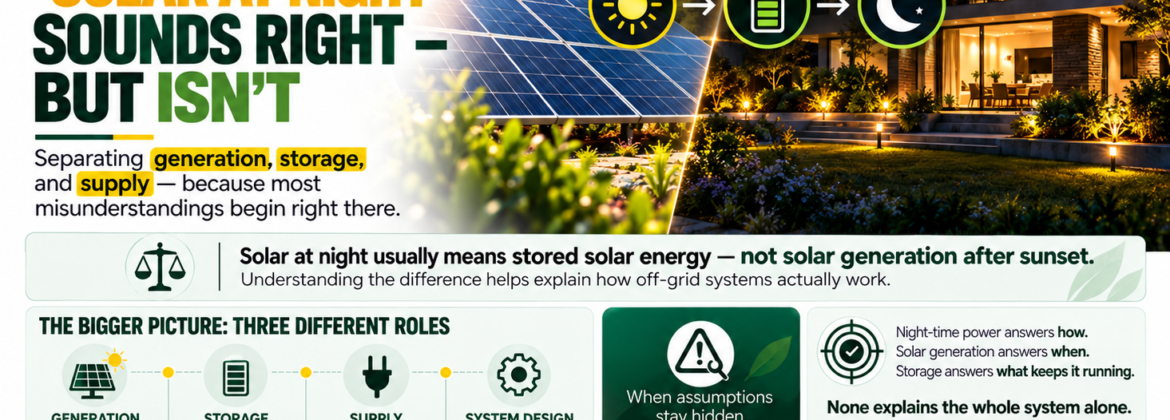
Why generation, storage, and supply are often confused — and why new technologies don’t change the fundamentals One of the most persistent ideas in solar conversations is also one of the most intuitively appealing: “This system works even at night.” It appears in many forms — sometimes subtle, sometimes explicit — and it resurfaces whenever […]

Mr. Abis Husein Abis Husein is an energy strategist and researcher and the founder & chief of technology at Sustainable Energies Enterprise (SEE). He is a regular columnist for leading Pakistani publications, including Dawn and The Express Tribune, writing on Pakistan’s clean energy transition. The Great Widening Look anywhere. Politics, religion, science, journalism, even family […]
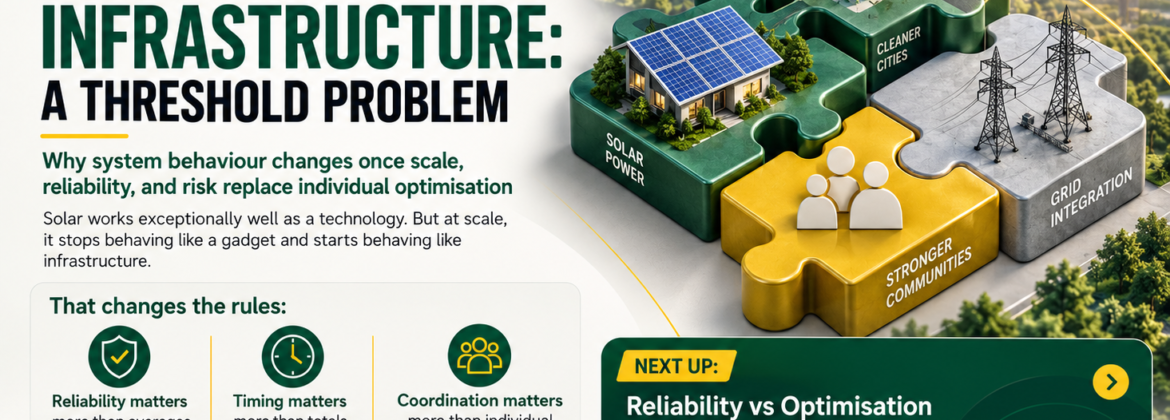
Why system behaviour changes once scale, reliability, and risk replace individual optimisation Why Scale Changes the Conversation For a long time, grid-tied solar could be treated as: ⚡optional, ⚡modular, ⚡individually beneficial, ⚡system-neutral. At low penetration, this framing mostly holds. But systems behave differently once a threshold is crossed. Beyond that point, solar no longer behaves […]
Why Energy Discussions So Often Go Nowhere Discussions around solar and energy policy in Pakistan tend to be intense, repetitive, and rarely productive. The same themes resurface again and again: ⚡Is solar being encouraged or discouraged? ⚡Is net metering being “ended” or “fixed”? ⚡Are policies fair or unfair? ⚡Who is responsible for rising costs? Yet […]
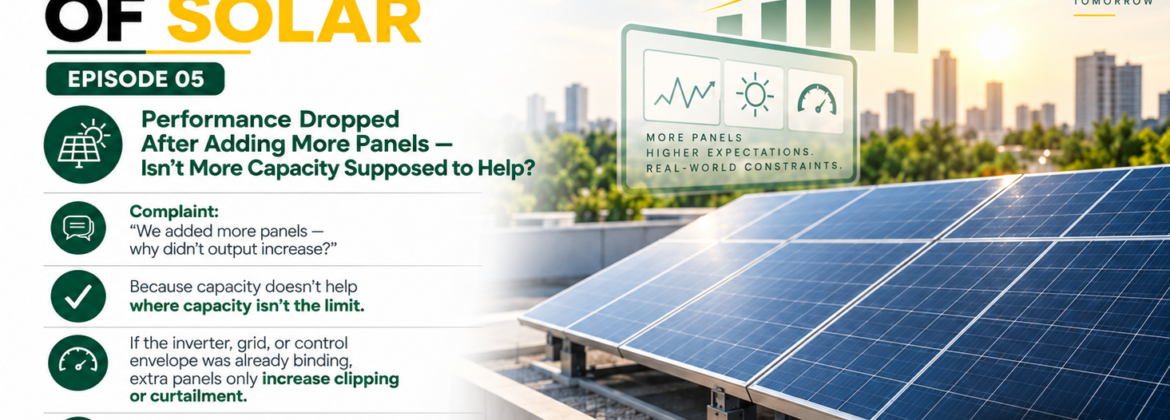
A recurring escalation scenario:“We added more panels, but performance didn’t improve — in fact, it looks worse.” The expectation behind the complaint is straightforward: ⚡More DC capacity should produce more AC output. ⚡If irradiance is available, the inverter should convert it. ⚡Therefore, system yield should increase proportionally. And yet, post-expansion monitoring often reveals: ⚡unchanged peak […]
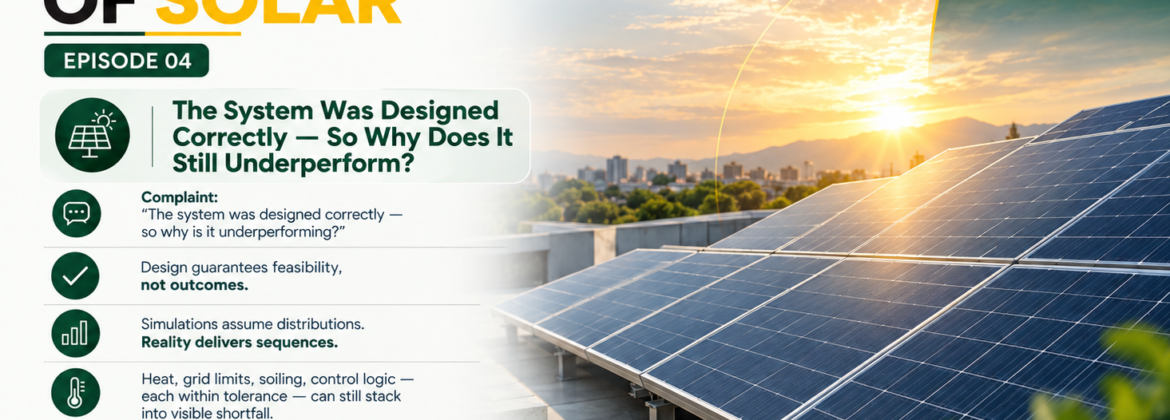
A familiar assertion:“The system was designed correctly — so why is it underperforming?” Design documents check out. Component sizing is appropriate. Ratios are within norms. Simulations looked acceptable. And yet, real-world output falls short of expectation — persistently enough to raise concern. The instinctive response is to search for an error: ⚡miscalculation, ⚡faulty equipment, ⚡installation […]
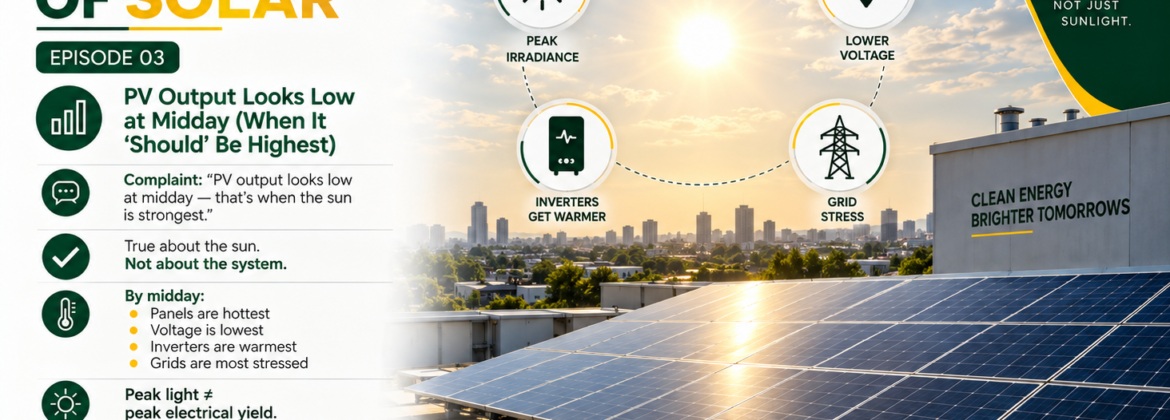
A recurring observation: “PV output looks low at midday — that’s when the sun is strongest.” The premise feels obvious. Solar irradiance peaks around midday. Therefore, system output should too. And yet, field curves often show: ⚡flattened peaks, ⚡gentle dips, ⚡or plateaus lower than expected. This is frequently interpreted as underperformance. In reality, midday is […]
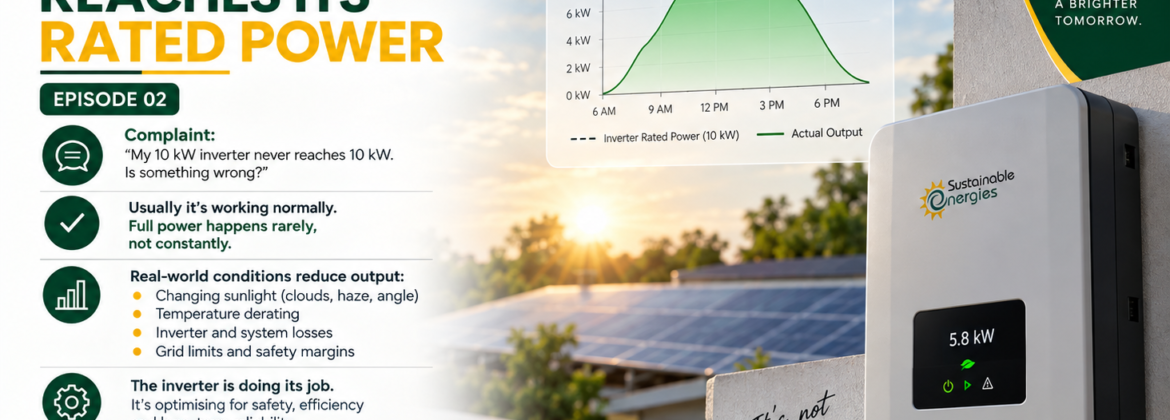
Another familiar complaint: “The inverter never reaches its rated power.” The rating is known. The conditions seem favourable. The expectation feels reasonable. And yet, peak output plateaus below the nameplate value—sometimes consistently, sometimes intermittently. This is rarely an inverter problem. It is almost always a modelling problem. Applying Diagnostic Reasoning Step 1: Identify what “rated […]
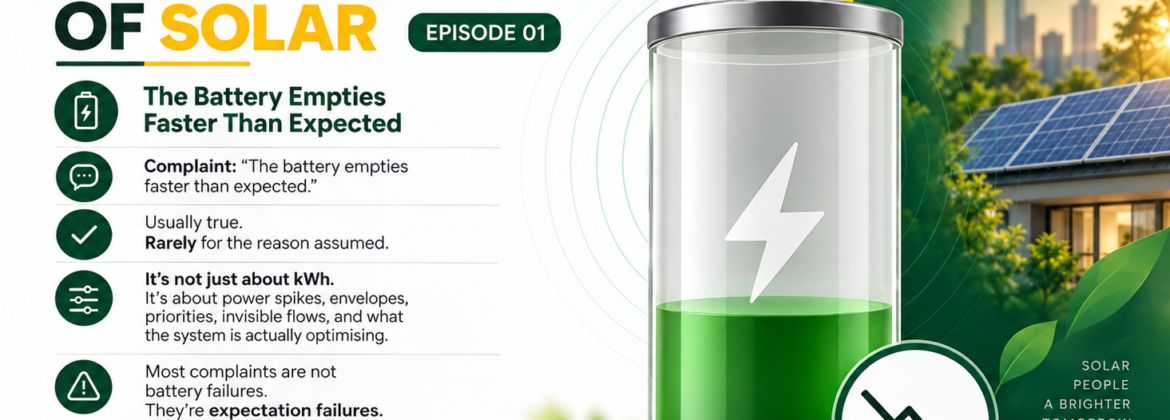
Few complaints are as common—or as confidently stated—as this one: “The battery empties much faster than expected.” It is usually followed by a number: ⚡“It’s a 10 kWh battery.” ⚡“The load is only 2 kW.” ⚡“It should last five hours.” The math feels simple. The reality rarely is. The mistake is not arithmetic. It is […]
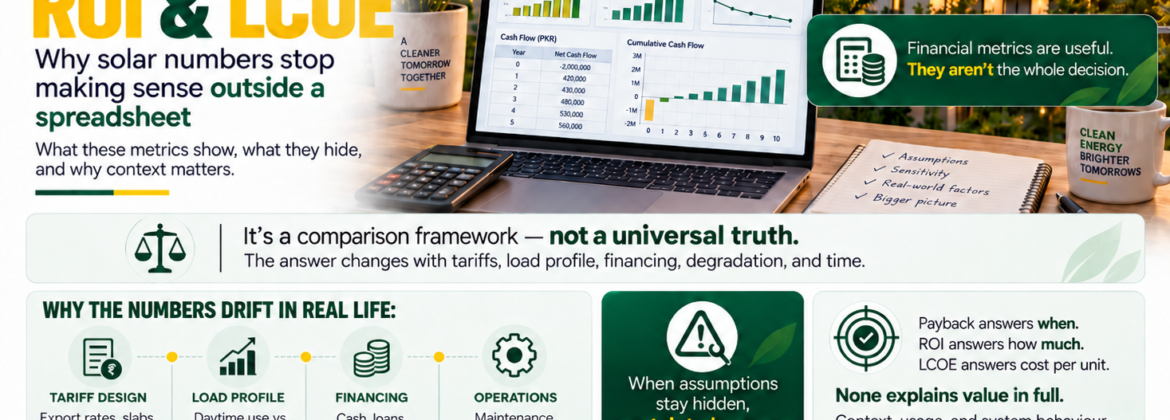
What these metrics actually measure — and what they quietly ignore Few things feel more reassuring in a solar discussion than a clean number. ⚡ Payback: 4.8 years ⚡ ROI: 22% ⚡ LCOE: lower than the grid They feel objective. They feel comparable. They feel final. And yet, many solar projects that look excellent on […]


