
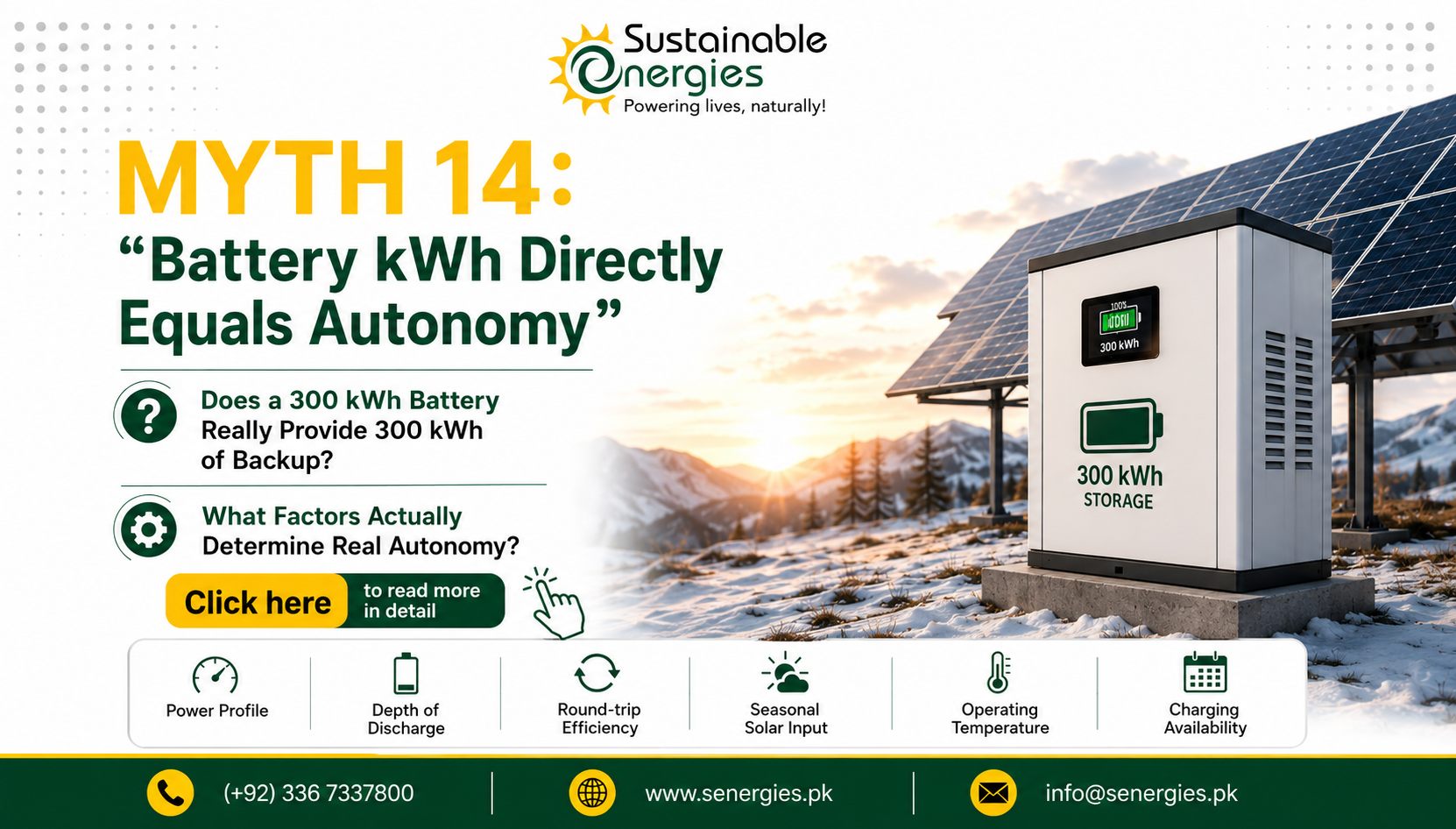
The Myth
“If the load needs 300 kWh, then a 300 kWh battery will give the required autonomy.”
This assumption is extremely common in hybrid and off-grid system discussions, and it is one of the most frequent causes of unexpected winter failures.
Why This Sounds Logical
The assumption appears reasonable because the
On paper, the math seems complete. In reality, it is not.
What’s Actually True
Battery autonomy is not defined by energy alone.
It depends on:
A battery that contains 300 kWh does not necessarily deliver 300 kWh when it matters.
The Winter Interaction Most Designs Miss
In winter:
So the same battery that appears sufficient on a summer day may never fully recover in winter.
This is how autonomy erodes silently over consecutive days.
The Practical Reality
Autonomy is a time-domain problem, not a static energy balance.
Two systems with the same battery kWh can behave very differently depending on the following:
How to Explain This Clearly to Clients
“Battery capacity tells us how much energy can be stored. Autonomy depends on how fast we use it and how reliably we can recharge it.”
Or:
“kWh defines storage size, not guaranteed backup time.”
A Simple Way to Think About It
A battery is like a water tank:
A large tank with a weak refill will still run dry.
Why This Myth Matters
When battery kWh is treated as autonomy:
Reliable autonomy comes from matching storage, power, and seasonal energy input — not from kWh alone.