
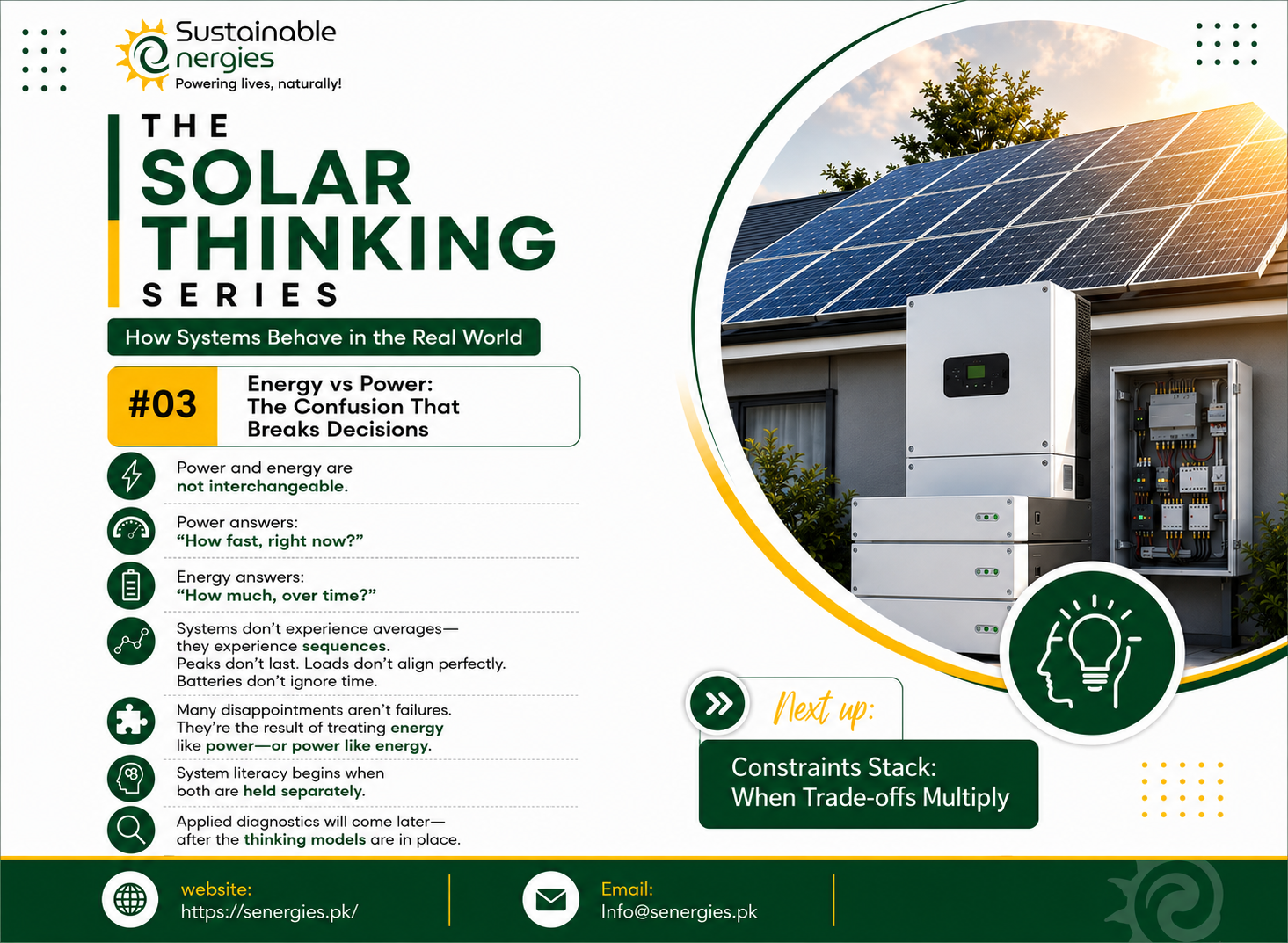
Few misunderstandings cause more persistent design errors, misaligned expectations, and post-installation frustration than the quiet conflation of power and energy.
The terms are familiar. The units are known. And yet, in practice, they are routinely substituted for one another—sometimes unconsciously, sometimes deliberately.
Power answers a momentary question:
Power: How fast is energy being delivered right now?
Energy answers a cumulative one:
Energy: How much work has been done over time?
This distinction is foundational. But in real systems, it is often blurred by averages, shorthand explanations, and sales-oriented narratives that compress time into a single number.
Why the Confusion Happens
A PV system is described as as”1010 kW,” and expectations quickly follow:
In reality, power is instantaneous and fragile, while energy is accumulated and constrained by time.
A system may easily deliver high power for short intervals, yet struggle to sustain moderate power over longer durations. Conversely, a system may accumulate large amounts of energy across a day while rarely operating near peak power.
Where This Becomes Visible
This mismatch becomes visible in several common situations:
None of these outcomes require faults. They are the natural result of time being ignored in decision-making.
The Problem with Averages
The confusion deepens when averages enter the picture. Daily energy is divided by hours of sunlight to imply “average power.” Monthly yields are normalized into “equivalent full-load hours.” These tools are useful but dangerous when mistaken for real operating behavior.
The Key Reality: Systems do not experience averages. They experience sequences.
Clouds arrive in clusters, not fractions. Loads, ramps, spikes, and idles. Batteries charge and discharge unevenly. Grid conditions fluctuate unpredictably. When power availability and demand fail to overlap in time, energy alone cannot compensate.
This is why a system can be energy-sufficient but power-constrained—or power-capable but energy-starved.
Understanding Both Dimensions
System literacy requires holding both dimensions simultaneously:
Design errors occur when one is used as a proxy for the other.
Why Some Upgrades Disappoint
This distinction also explains why some upgrades disappoint.
Each intervention shifts one axis of the system, not the entire behavior space.
A Practical Mental Check
A useful mental check is simple:
When energy and power are separated cleanly, expectations become realistic. When they are blended, disappointment becomes inevitable—and explanations drift toward vague “losses” or perceived inefficiencies.
Conclusion
Power is about moments.
Energy is about endurance.
The Key Takeaway: Until both are respected as independent constraints, systems will continue to be judged by promises they were never designed to keep.
In later, separate pieces, these distinctions will be revisited through specific system behaviors and diagnostic reasoning—but only after the foundational models are established.