
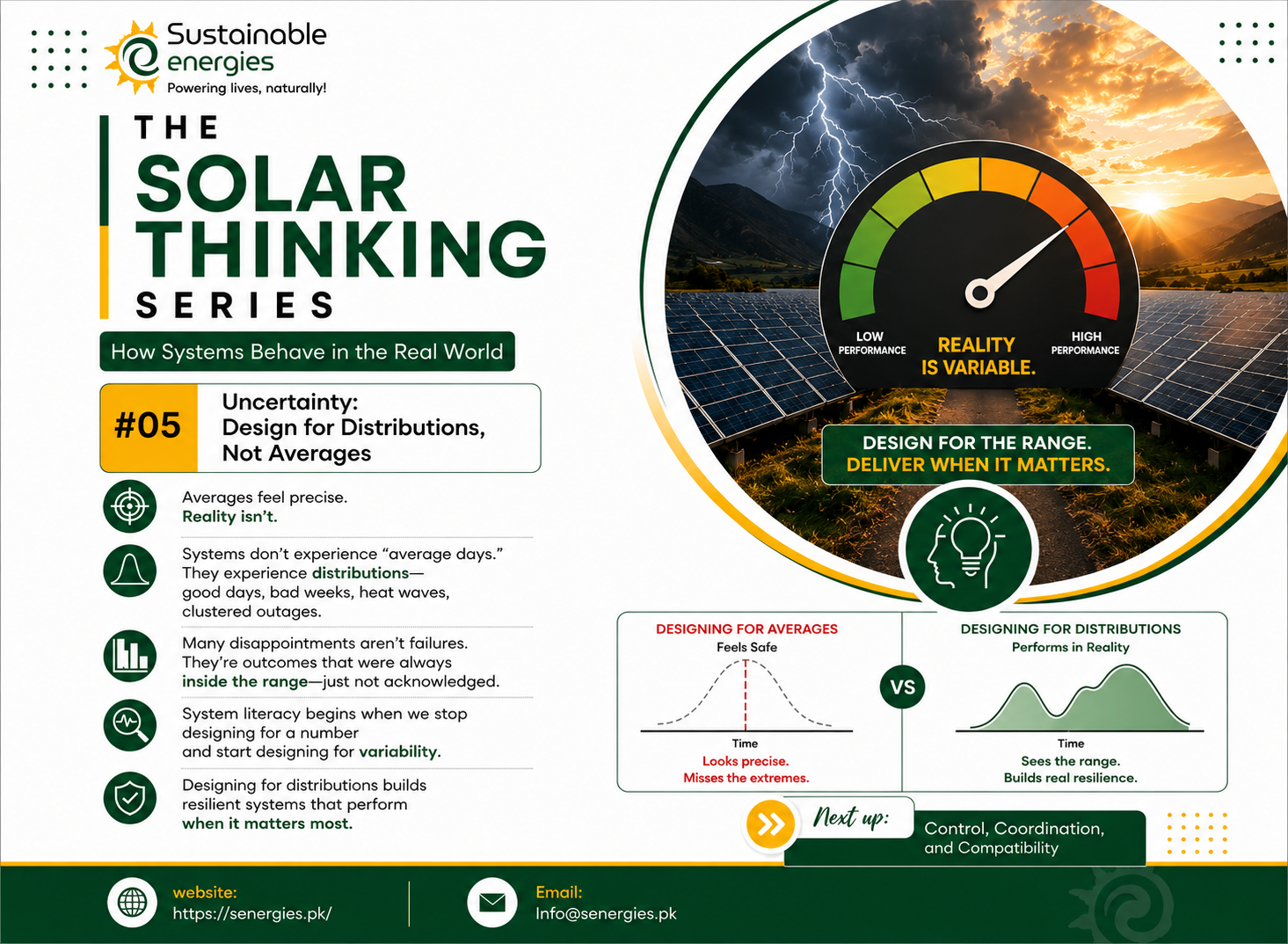
Averages are Comforting.
They compress complexity into a single number, create a sense of predictability, and allow decisions to be made quickly. In solar and energy storage, averages are everywhere: average daily yield, average sun hours, average load, average temperature, and average outage duration.
They are also one of the most common sources of misplaced confidence.
The Core Principle: Real systems do not experience averages. They experience variability.
Solar irradiance fluctuates minute by minute. Temperatures rise and fall unevenly. Loads arrive in bursts. Grid conditions degrade episodically. Human behavior introduces patterns that are repeatable but rarely smooth.
When systems are designed around averages, they perform acceptably on average—but struggle at the edges, where decisions matter most.
Where Average-Based Thinking Breaks Down
This becomes visible in familiar situations:
None of these outcomes contradict the averages used in design. They simply reveal what averages omit: the shape of reality.
Thinking Beyond Point Estimates
System literacy requires a shift from point estimates to distributions.
Instead of asking:
Common Question: “What is the expected output?”
The more robust question is
Better Question: “What range of outcomes should we expect, and how often?”
Averages describe the center of a distribution. Systems, however, are often stressed by their tails.
Reliability, satisfaction, and perceived performance are usually defined not by typical days, but by bad weeks, hot spells, clustered outages, or coincident constraints.
Designing for Distributions
This does not imply that systems must be designed for worst-case scenarios at all times. That would be impractical and expensive.
But it does require conscious decisions about which risks are accepted, which are mitigated, and which are transferred.
Designing for distributions means acknowledging trade-offs explicitly:
Without this framing, systems are judged against implicit expectations that were never articulated.
Why Averages Mislead After Installation
Averages also distort post-installation assessment. When performance is compared to a single expected number, natural variability is mistaken for inefficiency, and rare but predictable conditions are labeled as anomalies.
In reality, many systems perform exactly as their probability space dictates.
Conclusion
System literacy does not eliminate uncertainty.
It makes it visible.
By treating outcomes as ranges rather than points, decisions become more honest, explanations more accurate, and trade-offs more defensible.
The Key Takeaway: The goal is not to predict everything but to avoid being surprised by what was always possible.