
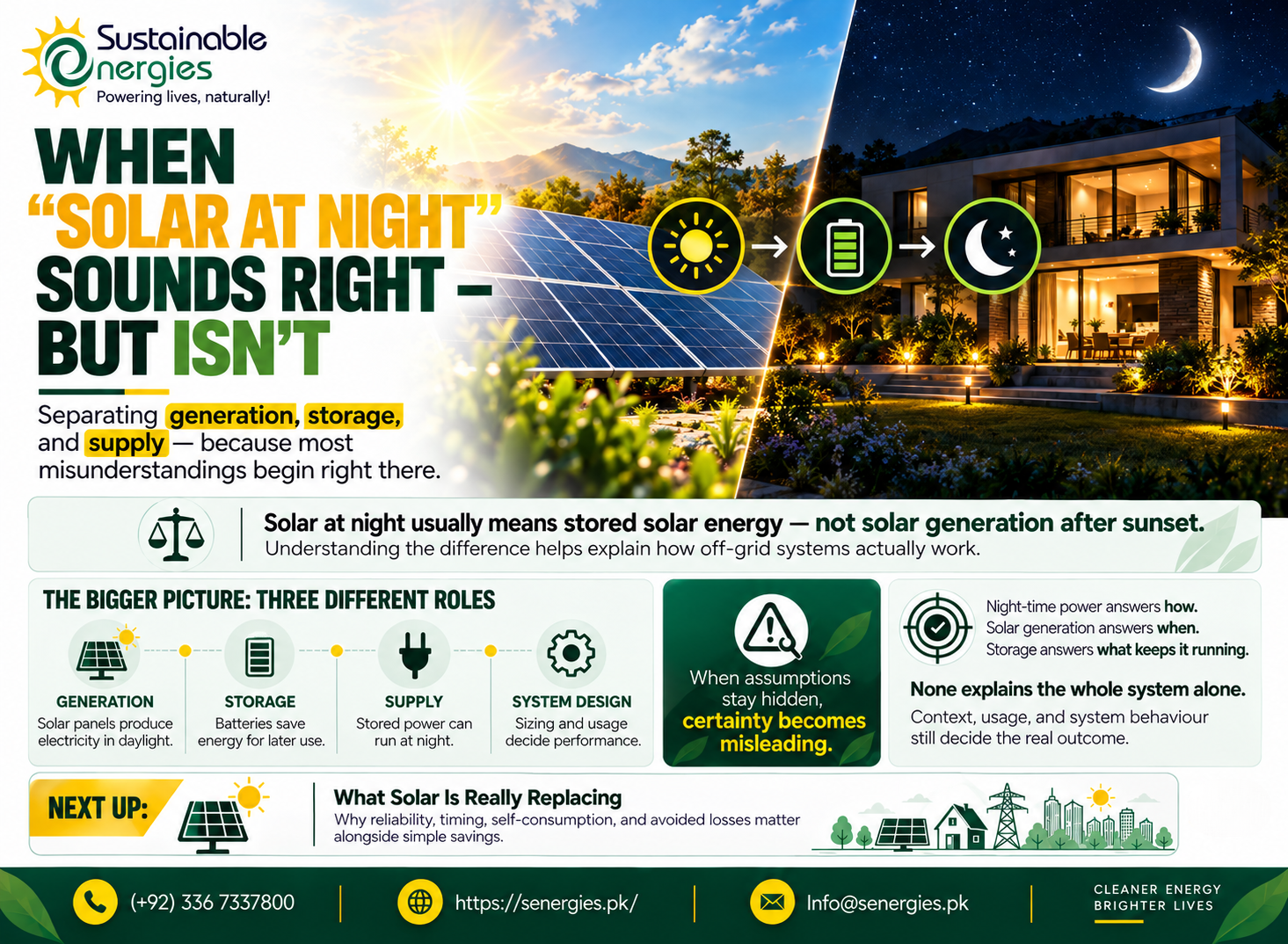
Why generation, storage, and supply are often confused — and why new technologies don’t change the fundamentals
One of the most persistent ideas in solar conversations is also one of the most intuitively appealing:
“This system works even at night.”
It appears in many forms — sometimes subtle, sometimes explicit — and it resurfaces whenever new panel technologies, hybrid systems, or storage options enter the discussion.
The problem is not that people are trying to mislead.
The problem is that several different concepts are being compressed into one sentence — and physics doesn’t survive that compression very well.
Why the Idea Sounds Reasonable
From a user’s point of view, the experience is simple:
From that perspective, saying “solar works at night” feels descriptive rather than false.
But it conflates three very different things:
Understanding where those lines blur is the key to understanding why this myth persists.
What Photovoltaics Actually Do
Photovoltaic cells convert incident photon energy into electrical energy.
No photons, no conversion.
That isn’t a limitation of silicon.
It isn’t a limitation of design.
It’s the defining principle of photovoltaics.
At night — in the absence of solar irradiance — a PV module does not generate electrical power in any meaningful, usable sense.
Anything that appears to contradict this is almost always a change in system boundaries, not a change in physics.
How Storage Gets Misattributed to Generation
In hybrid and off-grid systems, batteries supply energy after sunset.
From the user’s perspective:
But from a technical perspective, it matters a great deal.
Energy delivered at night is stored daytime energy.
Calling it night-time solar generation is like calling a water tank a spring.
The tank matters.
But it doesn’t change where the water came from.
Where “Low Light” Enters the Conversation
Another variation of the same myth appears as:
“These panels work better in low light.”
This statement is not entirely false — but it is rarely complete.
Low light does not mean no light.
It means lower irradiance levels, typically:
Some PV technologies perform relatively better than others under these conditions.
But “relatively better” is often misheard as “meaningfully productive”.
At low irradiance levels, absolute power output is still low — regardless of technology.
Artificial Light and the Scale Problem
Claims about panels working under artificial light often rely on a misunderstanding of scale.
Indoor lighting levels are typically:
Direct sunlight is:
Even with excellent spectral matching, the available energy indoors is orders of magnitude lower.
This is why:
can be powered by indoor PV — but buildings cannot.
The limitation is not efficiency.
It is energy density.
Why Different PV Technologies Exist
The persistence of these myths is reinforced by the fact that not all PV technologies behave identically.
Commercially and experimentally, we see:
Each exists to address specific constraints:
None exist to bypass the need for light.
Perceived Advantages vs Actual Trade-offs
When new PV technologies are discussed, claims often focus on:
All of these can be true within bounds.
What is often omitted is:
A panel that performs better under certain conditions does not eliminate the need for:
It simply shifts where compromises occur.
Bifacial Panels and the Reflection Trap
Bifacial modules are sometimes cited as evidence that panels can “harvest light from anywhere”.
In reality:
Moonlight, ambient glow, or street lighting contribute negligible energy compared to daylight irradiance.
Again, the physics hasn’t changed — only the marketing language has.
Why These Claims Persist
These ideas persist because:
A system can function acceptably while being conceptually misunderstood.
That makes correction uncomfortable — and often unnecessary from a sales perspective.
What Actually Changes When Technology Improves
When PV technology improves, what usually changes is:
What does not change:
Progress shifts constraints — it doesn’t remove them.
A More Accurate Way to Frame It
Instead of saying:
“Solar works at night”
A more accurate framing would be:
“Solar systems can supply power at night by storing energy generated during the day.”
Slightly longer.
Much more precise.
Far less myth-friendly.
Why This Matters Going Forward
As PV technologies diversify and systems become more hybridised, the risk of misplaced expectations increases.
Confusing generation with supply leads to:
Understanding where physics ends — and where system design begins — is essential for building systems that perform as expected.