
What Was Net Metering — And Why Did It Work So Well?
Under the original net metering framework, the deal was straightforward. If your solar panels generated more electricity than your home or business consumed at a given moment, the surplus was exported to the K-Electric grid. At the end of the month, that exported electricity was credited against what you imported from the grid at a 1:1 ratio — unit for unit, at the same tariff rate.
In practice, this meant a well-sized solar system could reduce a household’s electricity bill to near zero. Export during sunny daytime hours offset nighttime and early morning consumption. For commercial consumers, large daytime loads could be matched with solar generation, and any surplus was credited at the full commercial rate.
This was a powerful incentive that drove Pakistan’s solar boom — and it worked. Hundreds of thousands of systems were installed across the country between 2018 and 2025.
What Changed: Net Metering to Net Billing
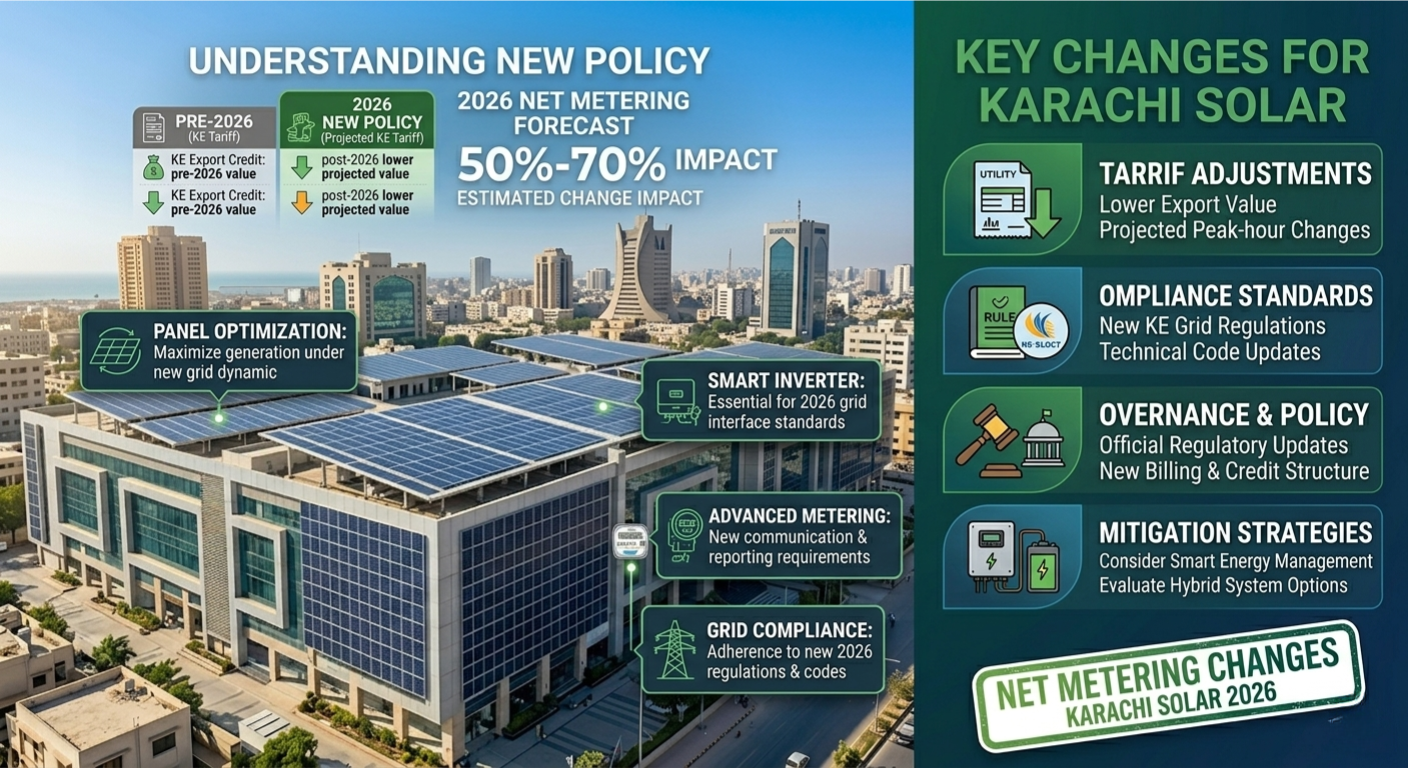
The NEPRA Prosumer Regulations 2025, which came into force in 2026, replaced the 1:1 credit system with net billing. The distinction matters enormously.
Under net billing, electricity you export to the grid is no longer credited at the rate you pay for electricity. Instead, it is credited at a lower buyback rate — currently in the range of PKR 11–13 per kWh — while you continue to pay PKR 60–90+ per kWh when importing from the grid.
To put this in plain terms: under the old system, exporting 100 units and importing 100 units meant you paid nothing. Under net billing, exporting 100 units earns you roughly PKR 1,100–1,300 in credit, while importing 100 units costs you PKR 6,000–9,000. The difference now comes straight out of your pocket.
The regulatory intent behind this change was to address grid stability concerns — utilities argued that solar consumers were effectively using the grid as a free battery, exporting at peak solar hours and drawing back at night without paying for that storage and transmission service.
Does This Mean Solar Is No Longer Worth It in Karachi?
No — but it changes how solar should be designed and used.
Under the old net metering system, the optimal strategy was sometimes to oversize a solar system and maximise export. Under net billing, that logic is inverted. Export at a low buyback rate delivers poor returns. Self-consumption is now where the value lies.
A solar system that is correctly sized to your daytime load — so that most of what is generated is consumed on-site rather than exported — remains highly economical. The electricity you generate and consume yourself still offsets what you would have paid K-Electric at the full tariff rate. That saving is real and unaffected by the net billing change.
For a Karachi home or business that consumes significant electricity during daylight hours — air conditioning, production machinery, office equipment — a well-sized solar system still pays back in 3 to 5 years. The key is that the system should now be sized to consumption, not to maximum generation.
What This Means for Hybrid Systems and Batteries
The net billing change has made hybrid solar systems with battery storage significantly more attractive than they were under the old framework.
Here is the logic: under net metering, you could export surplus power at full value and draw it back later at the same cost. There was little financial case for batteries — the grid served as a free storage mechanism.
Under net billing, surplus power exported to the grid is worth only a fraction of what you pay to import it. A battery system changes this equation. Instead of exporting surplus at PKR 11–13, you store it in a battery and use it at night — offsetting imports that would otherwise cost PKR 60–90. The financial return on battery storage has improved significantly as a result of this policy change.
For Karachi specifically, where K-Electric outages remain a reality, batteries were already valuable for backup purposes. The net billing change gives them a second and now financially compelling justification: maximising self-consumption to avoid importing from the grid at high rates.
The K-Electric Net Metering Application Process in 2026
For new systems going through the K-Electric net metering (now net billing) registration process in 2026, here is the current sequence:
Step 1 — System design and installation. Your solar installer designs and installs a system that complies with K-Electric’s technical standards. The inverter must be a grid-tied model with anti-islanding protection and IEC 62109 or equivalent certification. The installer must be a PEC-registered contractor.
Step 2 — Application submission. Your installer submits the net metering application through K-Electric’s online portal at ke.com.pk or at a KE Customer Care Centre in Karachi. Documentation required includes the system design drawings, load calculations, inverter certification, and the installer’s licence.
Step 3 — Site inspection. K-Electric conducts a site inspection to verify compliance. Systems that have NEPRA-approved inverters and complete documentation are approved faster. Missing or incorrect documentation is the most common cause of delays — often by several months.
Step 4 — Meter installation. Upon approval, K-Electric replaces your existing meter with a bidirectional meter that tracks both import and export. For residential systems up to 10 kW, expect a processing fee of approximately PKR 15,000–20,000.
Step 5 — NEPRA generation licence. For systems documentation to NEPRA for generation licence processing. This step is largely automated for smaller residential systems.
What If You Already Have a Net Metering Connection?
Existing net metering consumers in Karachi are in a transitional position. NEPRA’s regulations include provisions for existing prosumers, but the exact treatment — whether existing connections are grandfathered under the old 1:1 rate or migrated to net billing — has been subject to ongoing industry discussion and clarification.
The practical advice for existing solar owners is this: review your current inverter monitoring data to understand how much of your generation you are actually consuming on-site versus exporting. If you are exporting a significant proportion, the introduction of net billing will reduce your savings — and adding battery storage to increase self-consumption is worth evaluating.
Getting the Right Advice Before You Invest
The shift from net metering to net billing is exactly the kind of regulatory change that makes solar consultancy valuable before installation, not after. A system designed under the assumptions of the old framework may be significantly oversized for the new one — generating export that yields poor returns instead of sizing for self-consumption.
At Sustainable Energies Enterprise, we have been helping Karachi homes, businesses, and industries navigate the solar regulatory environment since 2012. We understand the NEPRA Prosumer Regulations and their practical implications for system design, component selection, and financial returns.
If you are planning a new installation or reviewing an existing one in light of the 2026 changes, our team can give you an honest, detailed picture of what makes sense for your specific situation.
Speak to SEE’s solar consultancy team today.
Sustainable Energies Enterprise | Bahadurabad, Karachi | (+92) 336 7337800 | info@senergies.pk