
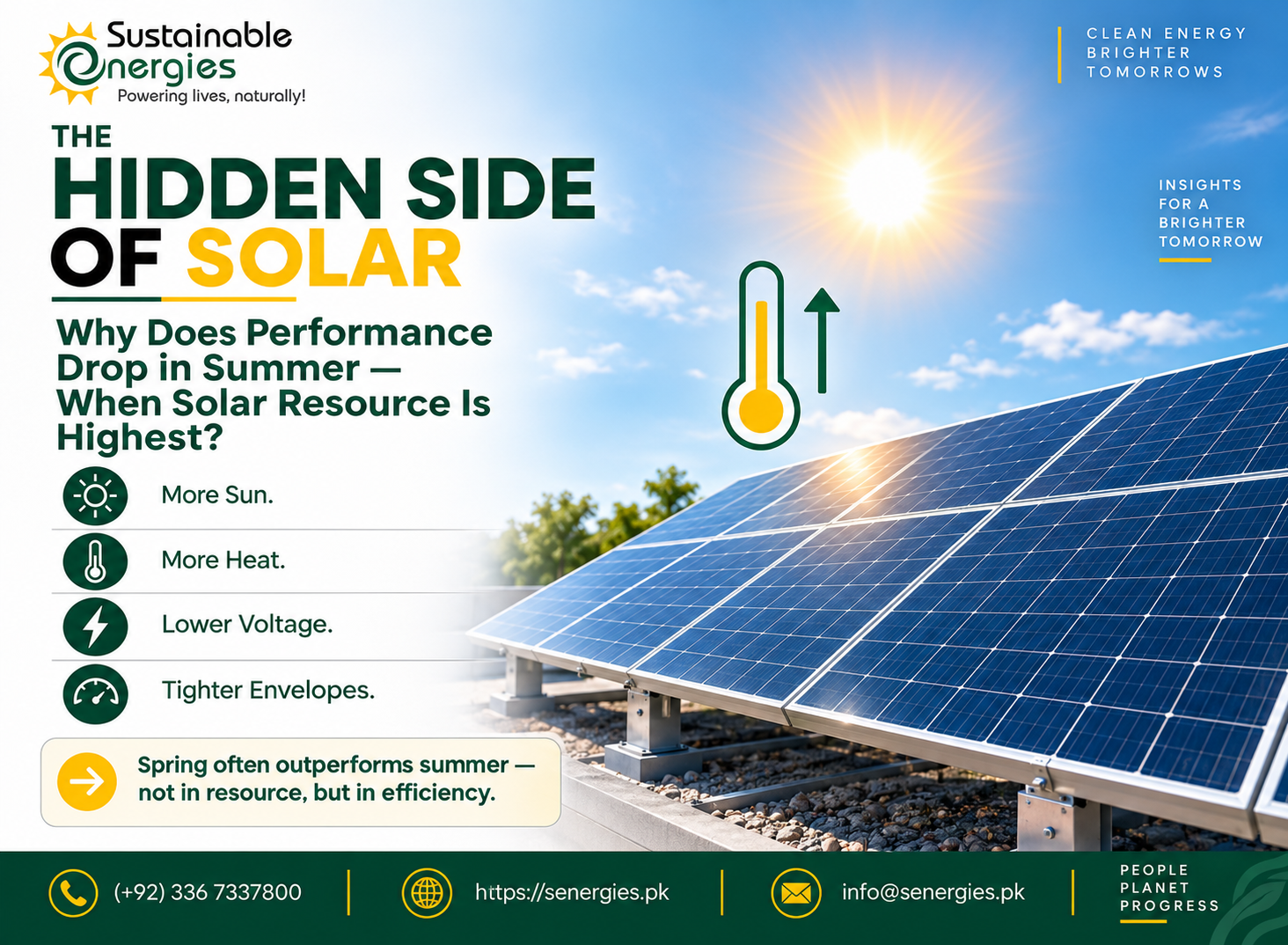
A recurring seasonal observation:
“We expected peak performance in summer — but output actually seems lower than spring.”
The expectation is intuitive.
Summer brings:
So system yield should scale upward accordingly.
And yet, many real-world performance curves show:
This is not a contradiction.
It is the result of thermal dominance within system behaviour.
Applying Diagnostic Reasoning
Step 1: Separate solar resource from electrical conversion efficiency
Solar irradiance measures incoming energy.
Electrical yield depends on conversion efficiency.
PV modules are semiconductor devices whose electrical performance declines as temperature rises.
With rising cell temperature:
So while irradiance peaks in summer, module conversion efficiency simultaneously declines.
The system receives more light — but converts it less efficiently.
Step 2: Understand temperature-driven voltage compression
Voltage loss is the dominant thermal effect.
As modules heat:
Even if current remains strong, falling voltage reduces total power.
This effect is most pronounced during peak irradiance hours — exactly when expectations are highest.
Step 3: Examine inverter thermal envelopes
PV modules are not the only components affected by heat.
Inverters operate within thermal envelopes that define safe operating limits.
Under elevated ambient temperatures:
Thermal derating is rarely abrupt. It manifests as sustained output plateaus rather than visible cutbacks — making it easy to overlook.
Step 4: Identify stacked summer constraints
Summer does not activate thermal limits in isolation. It amplifies multiple constraints simultaneously:
These constraints intersect — compressing deliverable output even while irradiance remains high.
Step 5: Reassess seasonal expectation baselines
Spring often produces the most visually impressive curves — not because irradiance peaks, but because temperature remains moderate.
Cooler modules maintain higher voltage and efficiency, allowing systems to operate further from thermal limits.
As a result, spring output can rival — or even exceed — summer output despite lower irradiance.
The expectation that “more sun equals more output” assumes constant efficiency, which does not hold thermally.
Step 6: Evaluate measurement framing
Seasonal comparisons often rely on:
Without normalising for temperature, irradiance, and daylight duration, performance comparisons can mislead.
A system may produce more total energy across summer while still appearing weaker in peak output behaviour.
What this symptom actually teaches
Solar resource and system performance are not linearly coupled.
Summer maximises input energy — but also activates the strongest thermal and operational constraints.
Peak system performance often occurs when irradiance and temperature sit in balance — not when irradiance alone peaks.
Understanding this reframes seasonal disappointment as thermodynamic reality, not system failure.