
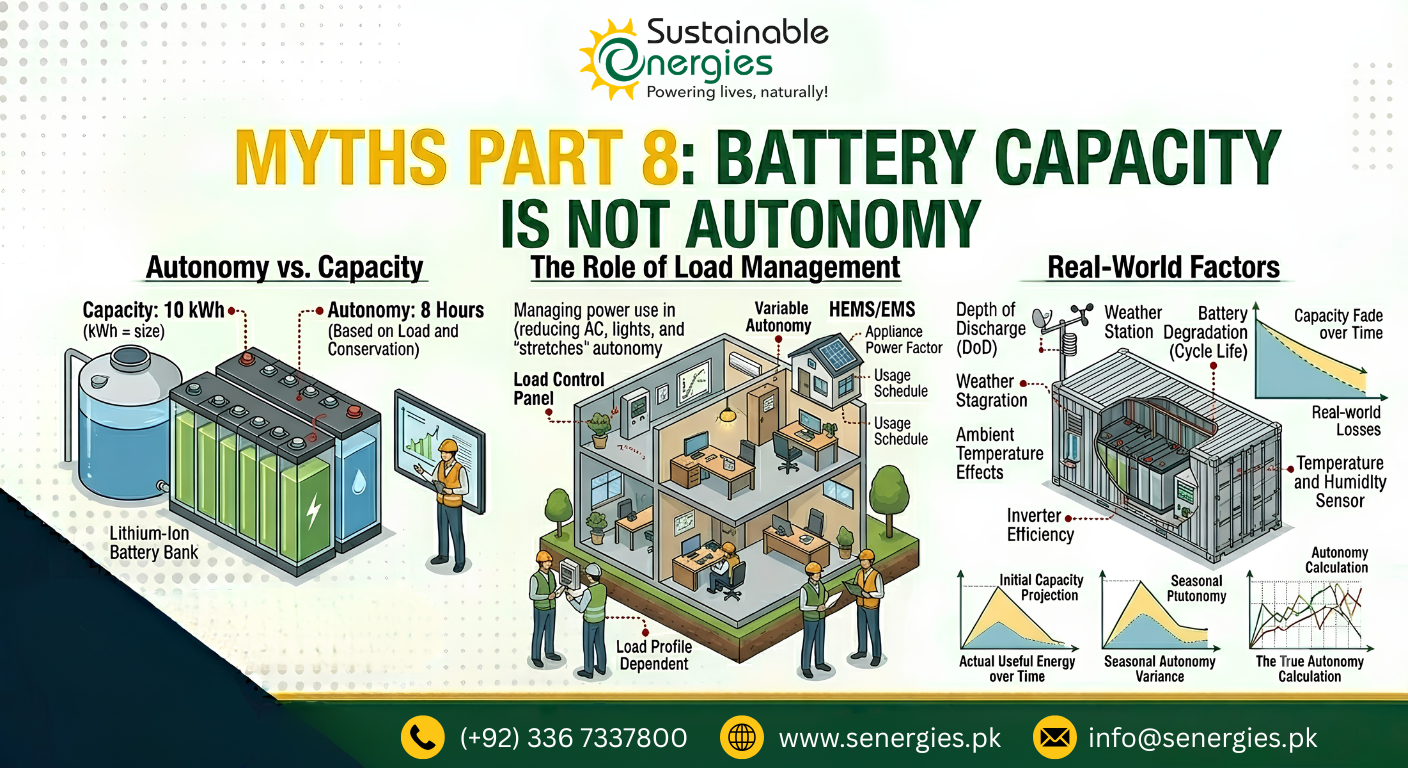
The Autonomy Trap: Why Battery Capacity (kWh) Does Not Equal Backup Time
Once seasonal thinking is corrected, the next major misconception in battery system design emerges: the false belief that battery capacity (kWh) directly equals backup time or autonomy. This belief appears completely logical, is heavily reinforced by manufacturer datasheets, and is widely repeated in commercial proposals.
It is also one of the most common reasons well-built battery energy storage systems (BESS) fail to behave as expected when grid instability strikes.
This article explains why autonomy is not a static number — and why time, power, and recovery metrics matter just as much as stored energy.
Myth 1: “If the load needs 300 kWh, a 300 kWh battery is enough”
The Misunderstanding
Battery storage systems are often sized using a deceptively simple energy balance calculation: matching the client’s load energy requirement (kWh) directly to the battery’s nameplate capacity (kWh). If the two numbers match, autonomy is assumed to be fully secured.
The Reality: Stored energy ≠ deliverable energy
The actual usable energy from a battery bank is tightly constrained by real-world engineering thresholds. A nominal “300 kWh battery” rarely delivers 300 kWh at the AC output repeatedly because of:
Ignoring these factors leads to a systematic overestimation of system autonomy from day one.
Myth 2: “Energy alone defines backup time”
The Misunderstanding
Autonomy is frequently treated as a flat, static math problem: Battery kWh ÷ Load kW = Backup Hours. This standard equation hides far more than it reveals about practical system behavior.
The Reality: Autonomy is a time-domain problem
Two commercial properties with identical battery capacities can experience completely different backup outcomes based on dynamic variables:
Battery systems are not just simple energy tanks; they are power-constrained devices operating across a moving time-scale.
Myth 3: “If the energy exists, the battery will recharge”
The Misunderstanding
System designs often assume that daily solar energy production automatically refills the battery bank no matter what. The common line of thought is: If total kWh in ≥ total kWh out, full recharge is guaranteed.
The Reality: Recovery is the true constraint
A battery’s ability to recover is heavily throttled by technical realities rather than simple availability. Recharge rates are strictly limited by available charging power, the duration of the effective daytime solar window, and charge tapering at high State of Charge (SoC).
Furthermore, concurrent daytime business loads often consume the solar generation before it can ever reach the battery. In winter, these recharge windows shrink precisely when rapid recovery is most critical. A battery that cannot fully recover between consecutive discharge cycles is not providing autonomy; it is accumulating a deficit.
The Overlooked Concept: SoC Drift
One of the most common BESS failure modes is slow, silent State of Charge (SoC) erosion:
No components break, and no alarms sound, but your backup capacity quietly disappears. Standard spreadsheet design methods completely miss this because they assume a flawless daily full recovery.
Why Power Matters as Much as Energy
Even if you possess sufficient nominal kWh storage, system performance can still drop due to hardware bottlenecks. Inverter limits may cap maximum discharge power, charging power may be insufficient to combat brief solar windows, and high-power startup loads can truncate autonomy prematurely.
Design Insight: Battery kWh is never a standalone design metric. PCS (Inverter) sizing is just as critical as storage block sizing. True system autonomy is always defined by a fluid interaction: Energy × Power × Time.
Conclusion: Sizing Battery Systems for Pakistan’s Climate
Battery kWh dominates commercial sales pitches because it is easy to visualize, aligns perfectly with pricing metrics, and fits simple math. But storage behavior is highly dynamic.
In Pakistan’s climate, ignoring operational realities can be costly. High ambient temperatures actively reduce usable capacity, winter solar windows severely shorten recovery times, and sudden grid instability increases the required discharge frequency. Systems designed under ideal assumptions will fail when real-world conditions hit.
Instead of asking a static question like: “How many kWh does this battery have?”
Industrial decision-makers must ask: “Can the battery bank fully recover after the worst expected discharge sequence, during the worst weather month of the year?”
Answering this single question immediately exposes solar undersizing, PCS bottlenecks, and unrealistic autonomy claims. A battery that cannot reliably recover is not a backup system — it is a countdown timer. Autonomy is not just stored; it must be actively maintained over time.