
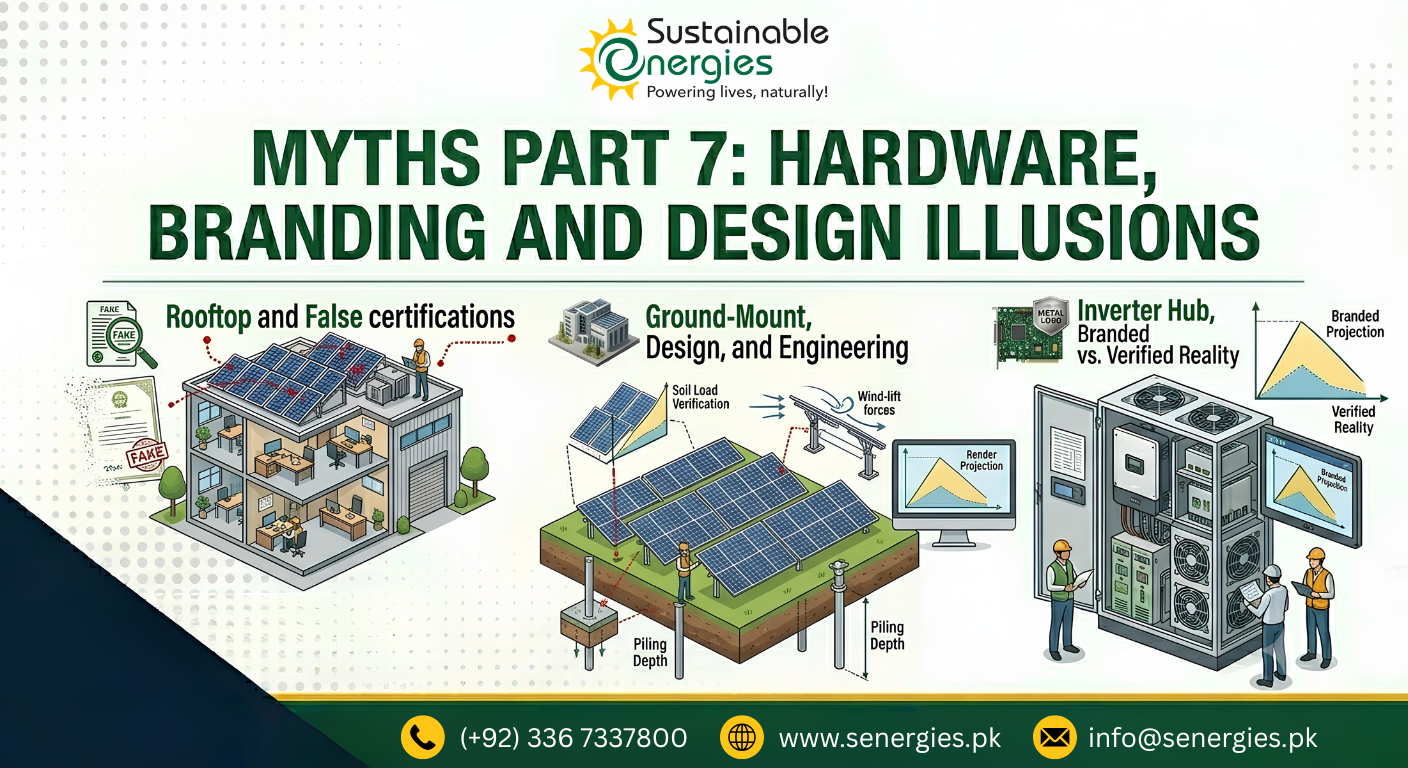
Hardware vs. Design: Debunking 4 Persistent Solar Equipment Myths in Pakistan
As Pakistan’s solar market has matured, attention has increasingly shifted from whether to install solar to what specific equipment to use. Unfortunately, this shift has also amplified a new class of myths — ones driven by aggressive branding, marketing labels, and visually appealing but poorly understood design choices.
This article addresses some of the most persistent hardware- and design-related misconceptions that directly affect system performance, cost-effectiveness, and long-term asset reliability.
Myth 1: “Tier-1 panels are the best panels”
The Misunderstanding
In Pakistan, the term “Tier-1” is widely used by consumers and non-technical stakeholders as a direct synonym for superior manufacturing quality, maximum output performance, and flawless product reliability. In practice, it means none of these things — at least not directly.
The Reality: Tier-1 is a bankability classification, not a quality rating
The “Tier-1” label originates strictly from financial and bankability criteria (such as BloombergNEF’s rating), not from rigorous lab testing or field performance evaluation. It primarily reflects:
It does not automatically guarantee the highest efficiency or the best degradation behavior for your specific project site. A Tier-1 manufacturer can produce multiple product tiers (ranging from budget to premium models), while a smaller, non-tier-rated manufacturer can produce an excellent, highly durable module.
The Danger: Treating Tier-1 as a technical guarantee discourages a proper specification datasheet review and shifts focus away from site-specific design constraints.
Myth 2: “Bifacial panels automatically produce more energy”
The Misunderstanding
Bifacial modules are often marketed as a direct, friction-free upgrade: “Same panel size, but you get extra energy completely free from the back side.” This creates a false impression that simply swapping out monofacial modules for bifacial ones guarantees a higher daily yield.
The Reality: Bifacial gain is highly system-dependent
Bifacial modules only produce additional energy if the backend layout is custom-engineered to allow it. Rear-side generation relies entirely on:
A Common Rooftop Failure Mode in Pakistan
On many commercial rooftops in Pakistan, modules are flush-mounted close to the surface with heavy steel or aluminum purlins running directly beneath them. Because the rear clearance is minimal and shadows are uneven, the bifacial premium delivers little to no real financial or energy benefit. Without the right conditions, a bifacial panel behaves just like a standard monofacial panel.
Myth 3: “Module choice matters more than structure”
The Misunderstanding
A massive amount of marketing emphasis is placed on panel brands, total cell wattage, and nominal efficiency percentages. Meanwhile, the actual mechanical mounting structure is treated as a minor utility concern, sometimes completely overlooked during budgeting.
The Reality: Structure determines your long-term yield
The mounting structure is not just a passive piece of metal; it is a performance-defining system component. It directly controls:
An average, well-engineered module installed on a highly optimized structure will easily outperform a premium, top-brand module that has been poorly oriented or structurally crowded.
Myth 4: “Standard white paint improves bifacial and PV performance”
The Misunderstanding
Applying basic white or light-colored protective coatings to a concrete roof is frequently assumed to be a quick, low-cost hack to maximize bifacial gains and lower system temperatures simultaneously.
The Reality: Visible brightness does not equal thermal reflectivity
Sunlight is divided into visible light (what our eyes see) and infrared radiation (what actually transfers heat). Ordinary household white paint reflects visible light reasonably well, but it often absorbs a major portion of infrared radiation over time.
Slapping a coat of generic white paint on a roof without evaluating the overall structure yields highly overestimated performance gains.
Conclusion: A Better Design Mindset for Equipment Selection
Across the industry, a repeating pattern emerges: market labels, materials, and standalone components are consistently mistaken for guaranteed energy outputs. In reality, peak performance emerges from unified system-level design. Hardware can only perform as well as its local operating conditions allow.
Instead of relying on basic questions like: “Is this panel Tier-1?” or “Is this setup bifacial?”
Engineering professionals must ask: “Under our specific site conditions, will this structural and component configuration actually convert more net energy?”
This mindset shift forces proper geometric calculations, realistic thermal analysis, and accurate commercial expectations. In PV assets, hardware enables performance — but design determines it. Branding supports bankability, but only engineering delivers energy.