
Legal Protection or Broken Expectations? The Truth About Solar EPC Contracts in Pakistan
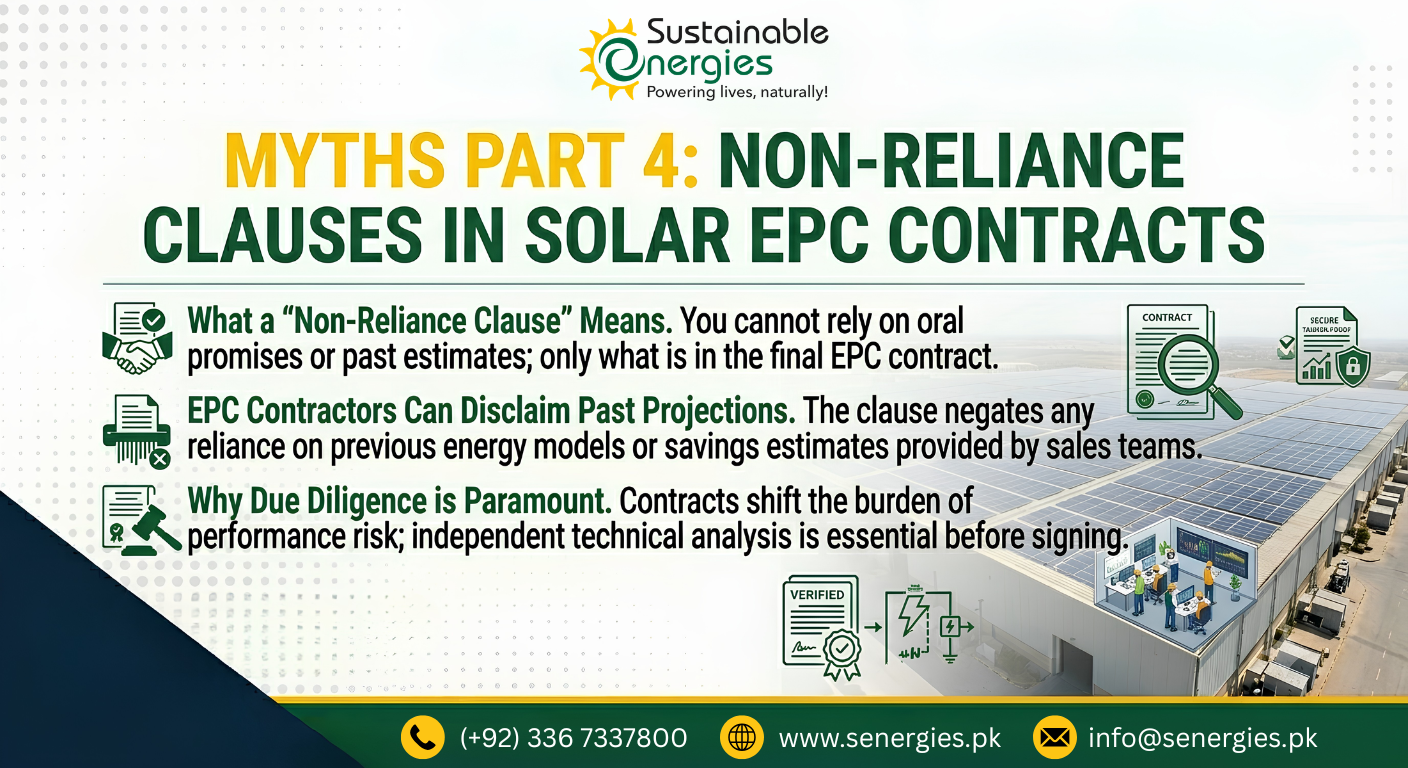
A clause increasingly found in solar EPC (Engineering, Procurement, and Construction) contracts reads something like this: “The parties acknowledge that they do not rely on any representations or statements not expressly set out in this agreement…”
At first glance, this appears to be a routine legal safeguard — and in many ways, it is. However, in the context of solar PV and Battery Energy Storage Systems (BESS), such clauses raise important questions about how systems are explained before signing, how expectations are formed, and where the responsibility for understanding really lies.
This article examines what non-reliance clauses actually do in practice — and why their growing prevalence reflects deeper issues in how industrial solar systems are sold and understood in Pakistan.
Why Non-Reliance Clauses Exist in Solar Contracts
From a strictly legal perspective, these clauses are meant to protect both parties, but primarily the contractor, by achieving the following:
While common across many industries, their rapid rise in solar EPC contracts correlates directly with increasing system complexity, weather-dependent performance variability, and financial disputes driven by mismatched client expectations.
The Practical Effect: Beyond the Legal Language
In practical terms, once you sign a contract containing a non-reliance clause, the following elements lose all legal standing unless they are explicitly written into the final contract text:
The only real legal exception is fraudulent misrepresentation, which requires proving deliberate intent to deceive — an exceptionally high bar to clear in complex technical sales. As a result, most incomplete or overly optimistic explanations remain legally neutral, even if they materially influenced your decision to purchase the system.
Why This Matters Deeply in Solar and Energy Storage
Solar PV and battery assets are inherently probabilistic, seasonal, assumption-sensitive, and time-dependent. Yet, sales narratives frequently rely on annual averages presented as guarantees, typical behavior implied as 100% reliable, and simplified rules of thumb used as absolute predictive tools.
These explanations may not be deliberately false, but they are technically incomplete. When these assumptions are later contradicted by poor winter performance, unsegregated load behaviors, or low battery recovery limits, the non-reliance clause acts as an unyielding boundary between technical reality and commercial accountability.
The Uncomfortable Truth: Non-reliance clauses do not create misinformation — they allow it to safely persist. They unintentionally reduce the pressure on sales teams to qualify their claims, shifting the heavy burden of technical interpretation to the least-informed party (the client). In effect, they serve as a legal patch over a technical educational gap.
Why “Fraud” is a Weak Safeguard Here
Most misleading solar claims are not legally fraudulent. They are simply assumption-based, oversimplified, or derived from outdated industry rules of thumb repeated without full engineering context. Legally, this falls under negligence or standard sales talk rather than fraud, meaning most harmful misunderstandings easily survive contractual scrutiny.
How End-Users and EPCs Should Navigate This
What This Means for End-Users (Commercial Clients)
Corporate buyers should not fear these clauses, but they must treat them as a checklist. Before signing, take these practical steps:
What This Means for Professional EPCs
For top-tier engineering firms, a non-reliance clause should be a last line of defense, not a primary shield to hide behind. Long-term commercial credibility is better protected by clearly stating engineering assumptions, using highly qualified performance language, and hosting honest discussions about system limits and variability.
Conclusion: A Better Industry Direction
The ultimate goal for the Pakistani solar market should not be the removal of non-reliance clauses. Instead, the goal should be to make them completely irrelevant. This can only be achieved by aligning sales narratives with engineering reality, documenting baseline assumptions transparently, and treating resource uncertainty as something to explain rather than hide.
When project expectations are engineered correctly from day one, legal disputes drop, corporate trust increases, and protective contract clauses become simple formalities rather than defensive shields.
Closing Thought: Legal disclaimers cannot compensate for technical ambiguity. In commercial energy systems, absolute clarity is the strongest form of protection — for clients and EPCs alike.