
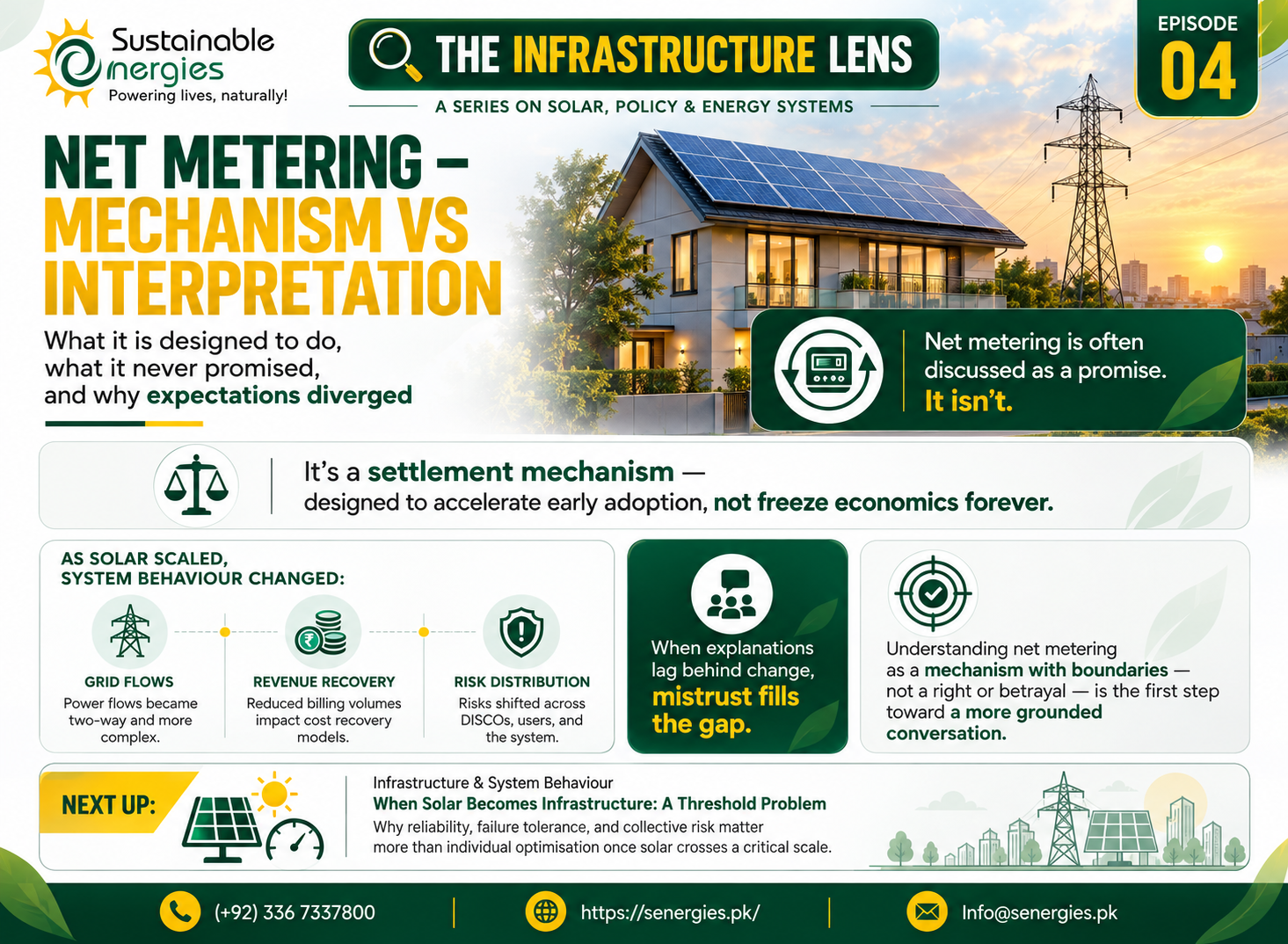
What it is designed to do, what it never promised, and why expectations diverged
Why Net Metering Became a Flashpoint
Net metering sits at the intersection of:
As a result, it attracts more emotion than most technical mechanisms.
Much of the disagreement around net metering is not about the mechanism itself, but about what people believe it represents:
To understand where expectations diverged, it helps to first clarify what net metering actually is — and what it is not.
Net Metering Is a Mechanism, Not a Promise
At its core, net metering is a settlement mechanism. It allows:
What it does not inherently guarantee:
These limits are not policy failures — they are design boundaries.
Policy Intent vs System Behaviour
The policy intent behind net metering was broadly aligned around:
As penetration increased, system behaviour evolved.
This is not unusual.
A useful analogy here is house building in Pakistan:
An approved architectural drawing expresses intent. The lived outcome depends on:
No one expects the drawing alone to guarantee comfort, cost, or timelines.
Policy operates the same way.
Where Interpretation Drifted
Over time, several interpretations solidified — often unintentionally:
These interpretations did not arise from bad faith. They arose from early-stage success being extrapolated linearly.
Stakeholder Pressures
As net metering scaled, different pressures emerged — often simultaneously:
These pressures are real — and unresolved.
They are not proof of conspiracy. They are symptoms of system transition.
Why Mistrust Filled the Gaps
When system behaviour changes faster than explanation:
In such environments, people look for motives because process clarity is missing.
This series does not attempt to assign motives. It attempts to make the process legible again.
Engineering & Economic Perspective
From an engineering and economic standpoint:
The challenge is not whether to adjust, but how transparently and symmetrically adjustments are made.
Closing Note
Net metering did not fail. It did what it was designed to do — and revealed the next layer of constraints.
Understanding that difference is essential before judging outcomes, intent, or future direction.