
Designing BESS for Worst-Case Reality: Why Solar Averages Fail Winter Autonomy in Pakistan
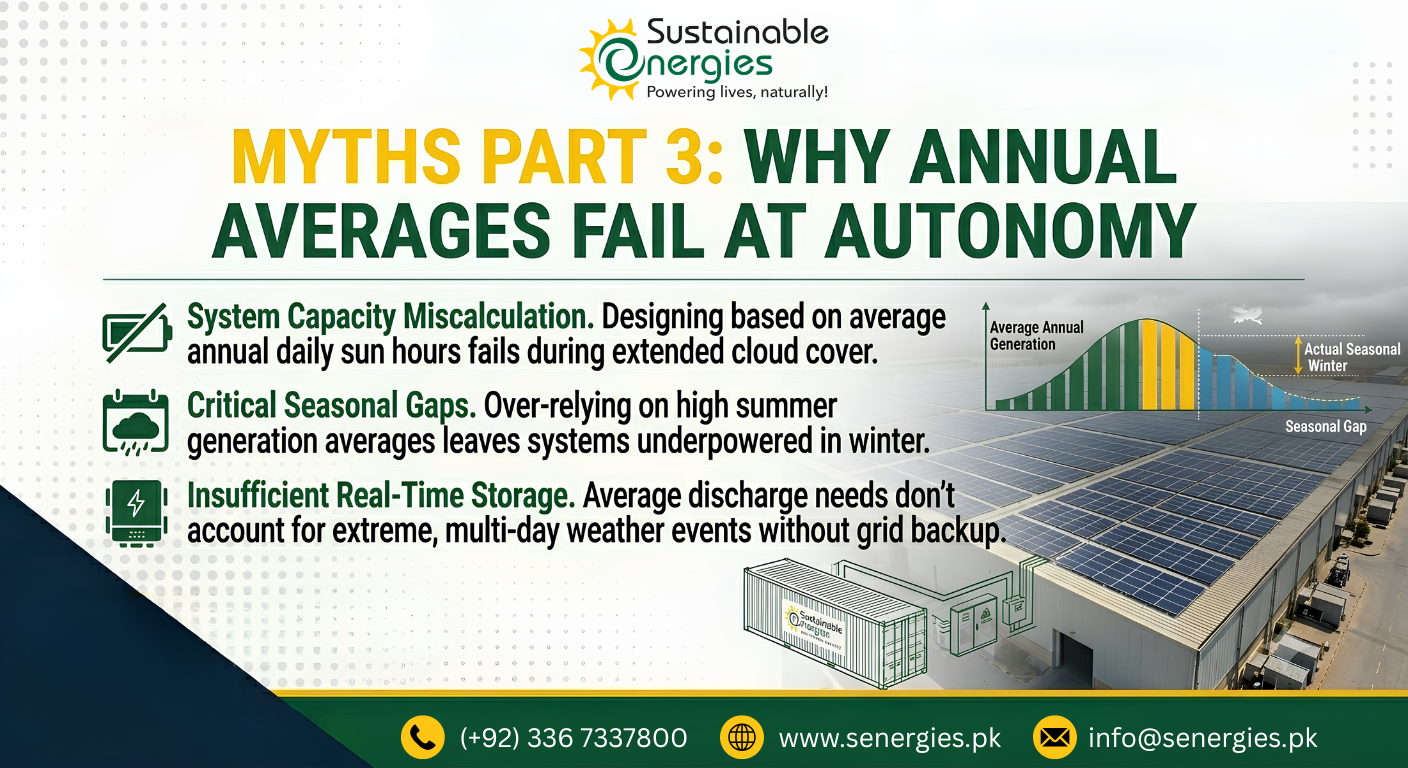
Battery Energy Storage Systems (BESS) are increasingly deployed alongside solar PV in Pakistan — for backup, peak shaving, and grid support. Yet many of these systems underperform not because the hardware is bad, but because they are designed using annual averages instead of worst-case conditions.
This article addresses one of the most damaging misconceptions in solar-plus-storage design: the false belief that if a storage system works “on average,” it will work reliably when it is needed most.
Myth 1: “Annual average solar is good enough for autonomy”
The Misunderstanding
Energy Storage Systems (ESS) are frequently sized using annual or long-term average insolation data, typical daily production metrics, and “most of the year” performance models. This creates false confidence — especially when system dashboards look incredibly healthy during peak summer months.
The Reality: Autonomy failures do not occur on average days
Battery systems don’t experience blackouts or dropouts during clear, standard days. Instead, critical system failures occur during specific high-risk windows:
Designing for averages guarantees that safety margins completely disappear exactly when reliability matters most, causing the Loss of Load Probability (LOLP) to rise sharply.
Myth 2: “If it works in summer, the design is sound”
The Misunderstanding
Summer operations are often treated as definitive proof of a system’s adequacy. Because summer offers long daylight hours, strong sun angles, and rapid battery recovery times, the underlying system design appears robust, stable, and highly forgiving.
The Reality: Summer hides structural weaknesses
During the summer, wide charging windows and highly forgiving solar yields easily mask major system inefficiencies. Batteries start almost every single day fully charged. However, this high performance tells you very little about actual winter resilience.
Winter quickly exposes critical engineering flaws due to:
A BESS asset that performs flawlessly in June may be operating on the absolute edge of total collapse by December.
Myth 3: “Winter oversizing is wasteful”
The Misunderstanding
Designing a commercial solar-plus-storage layout specifically for winter performance inevitably leads to excess solar generation during summer. This excess energy is often labeled by non-technical stakeholders as an expensive inefficiency or wasteful design practice.
The Reality: Winter oversizing is strict risk management
If your winter autonomy requirements are identical to summer parameters — or if your load is mission-critical — winter insolation must define your total system size. In professional engineering, excess summer generation isn’t waste; it is an active insurance policy. A backup system that never fails is allowed to be functionally inefficient for a part of the year.
Why Winter is the Real Engineering Bottleneck
Winter combines multiple severe operational stressors simultaneously:
The Anatomy of a Silent BESS Failure
Loss of Load Probability (LOLP) is simply the likelihood that a storage system cannot meet its designated load when required. In battery setups, failure is rarely sudden or mechanical; it is probabilistic and cumulative. The silent failure pattern typically follows a predictable sequence:
Nothing physically breaks. The system simply runs out of operational headroom because it was engineered around a generic average.
Conclusion: A Better Question for BESS Design
Average-based thinking persists in the market because it simplifies sales pitches, aligns perfectly with basic vendor sizing tools, and avoids uncomfortable discussions about winter costs. But commercial convenience is not the same as structural reliability.
Instead of asking a general question like: “How does this battery system perform on average?”
Industrial professionals must ask: “Does the storage system fully recover its State of Charge (SoC) during the worst historical month of the year?”
Answering this specific question immediately reveals whether your solar array is sufficient, your charging power is adequate, and your battery capacity is genuinely meaningful. Storage systems are never defined by their best days. They are defined by the days they struggle. Designing for winter is not pessimism — it is professionalism.