
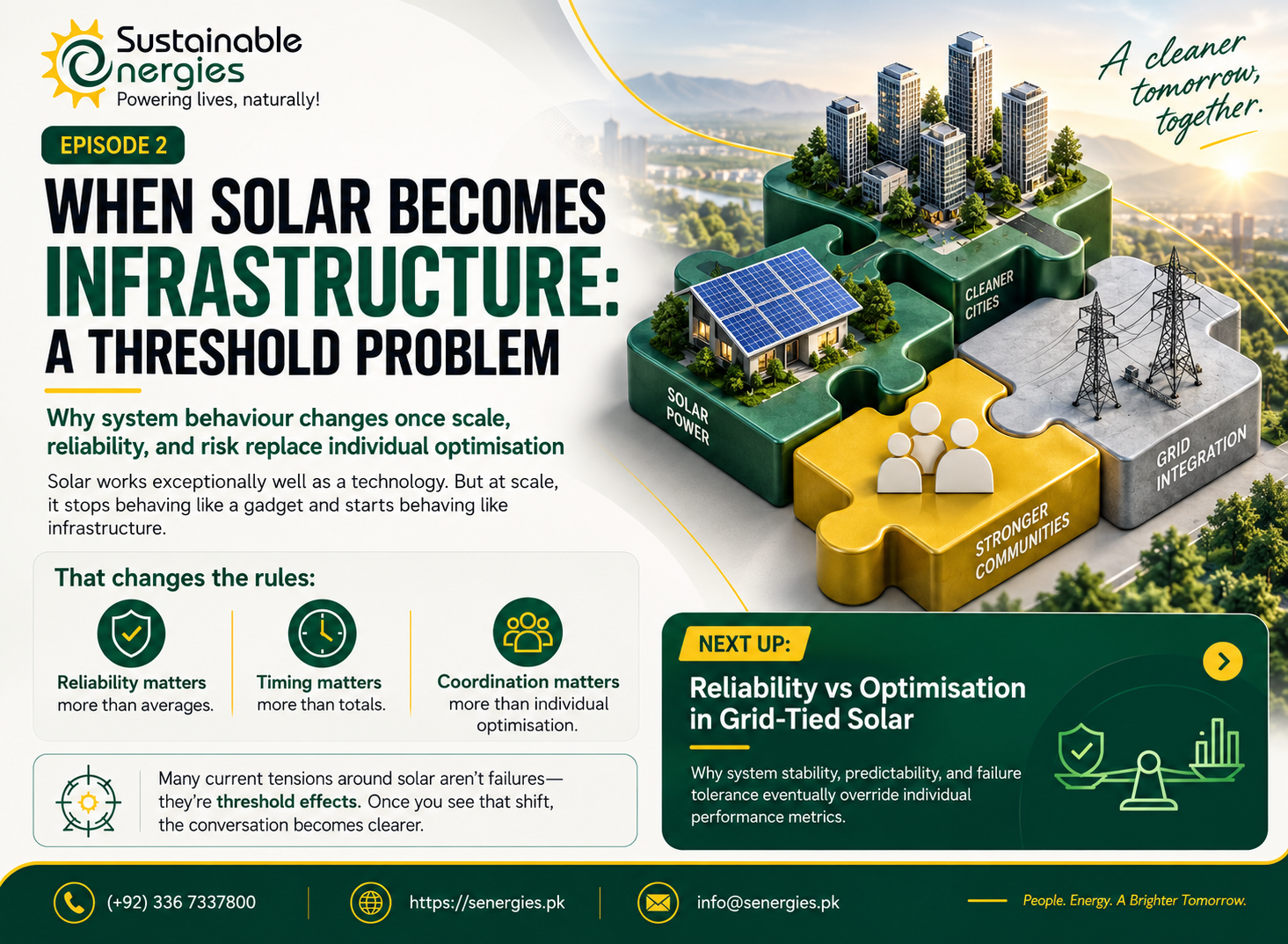
Why system behaviour changes once scale, reliability, and risk replace individual optimisation
Why Scale Changes the Conversation
For a long time, grid-tied solar could be treated as:
At low penetration, this framing mostly holds.
But systems behave differently once a threshold is crossed.
Beyond that point, solar no longer behaves like a technology choice made by individuals.
It begins to behave like infrastructure — influencing outcomes even for those who never opted in.
This is where many misunderstandings originate.
What “Infrastructure” Actually Means
Infrastructure is not defined by ownership or intent. It is defined by dependence.
A system becomes infrastructure when:
Roads, water supply, telecom networks — all crossed this threshold at some point.
Grid-tied solar has now crossed it too.
Reliability Replaces Optimisation
At the individual level, solar optimisation focuses on:
At the system level, priorities change:
A system that performs exceptionally most of the time but poorly when it matters is acceptable for gadgets — not for infrastructure.
This shift explains why system operators evaluate solar differently at scale than early adopters did at the beginning.
New Failure Modes Appear
When solar penetration increases, new behaviours emerge — even if every individual system works perfectly.
Examples include:
These are not equipment failures. They are system-level effects.
A simple analogy helps:
A city bus system works smoothly when a few people use it off-peak. At rush hour, scheduling, routing, and capacity suddenly matter more than individual convenience.
Solar behaves similarly once participation becomes widespread.
Why “Works Most Days” Is Not a System Metric
One of the hardest shifts for users is understanding that:
From a system perspective:
This does not make solar undesirable. It makes system integration unavoidable.
Distributed Generation Changes Risk Allocation
Another threshold effect is who carries risk.
At small scale:
At infrastructure scale:
This is why infrastructure systems inevitably introduce:
Not because of control — but because of interdependence.
Engineering & Economic Perspective
From an engineering and economic standpoint:
Ignoring this transition leads to repeated surprise and frustration.
Closing Note
Solar did not change. The system context did.
Once solar becomes infrastructure, it must be evaluated as infrastructure — with all the discipline, coordination, and trade-offs that implies.
Understanding this threshold is essential before discussing policy, fairness, or future direction.