
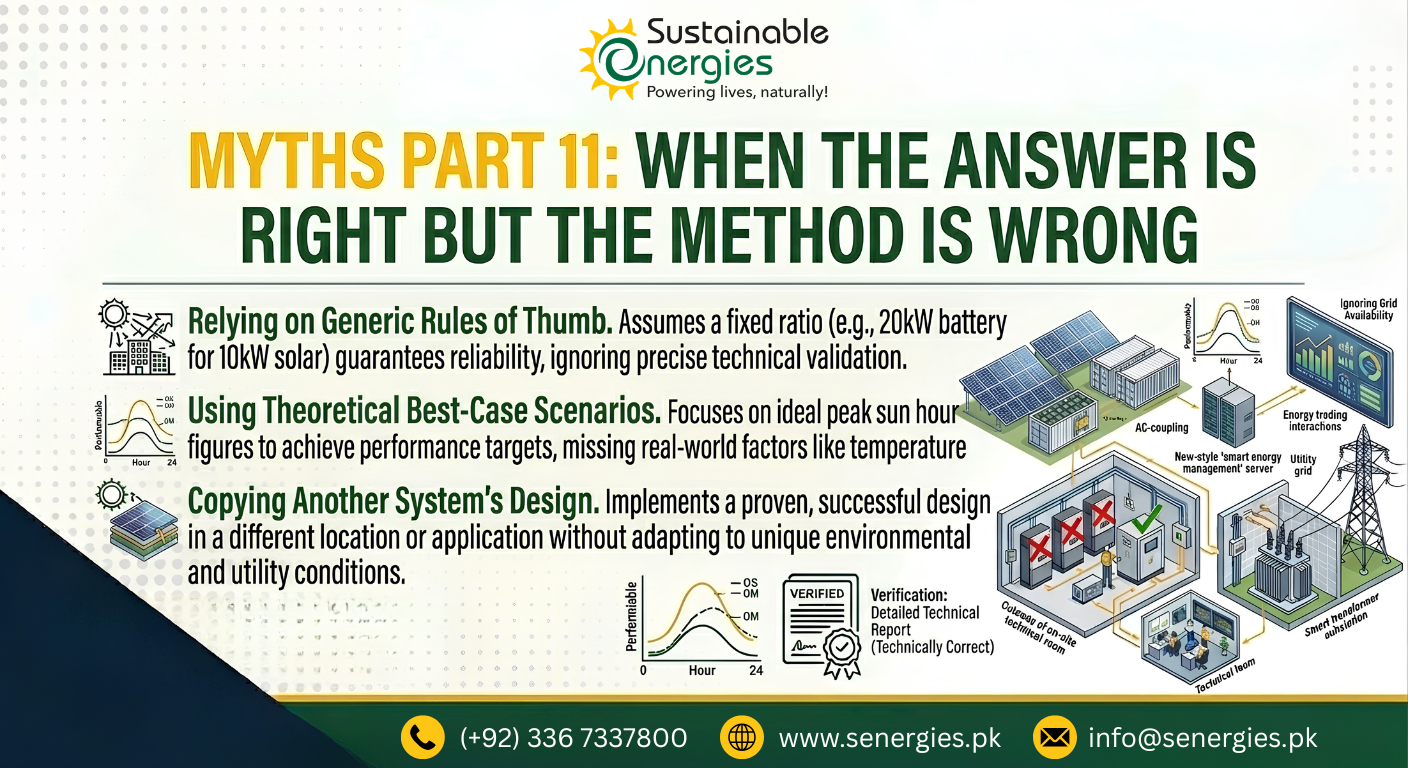
The Flaw in the Spreadsheet: A Closer Look at Common ESS Sizing Math
In solar-plus-storage system design, it is not uncommon to see calculations that arrive at a perfectly sensible-looking system size, yet rest on deeply misleading assumptions. This is particularly true for Energy Storage System (ESS) sizing, where quick spreadsheets and automated “design calculators” often compress complex, time-dependent behavior into tidy, linear arithmetic.
This article examines such an example — not to dispute the final numbers, but to explain why the method used to reach them is structurally fragile, and how the same engineering conclusion can be reached more honestly and with far less artificial complexity.
The Scenario (Simplified)
A typical commercial ESS sizing exercise presented to decision-makers usually looks like this:
The final hardware capacity appears reasonable — and in many cases, it actually works. However, the core problem lies not in the final destination, but in the dangerously flawed route taken to get there.
The Core Issue: Time Is Completely Removed
Most quick ESS sizing methods implicitly assume that solar energy arrives evenly during PSH, battery charging happens at a static, constant power, and daytime loads align neatly with generation curves. In reality, none of these assumptions hold consistently. Solar + battery assets live strictly in the time domain; any formula that ignores time will eventually misrepresent reality.
3 Dangerous Shortcuts in Standard Solar Proposals
Shortcut #1: Treating PSH as Fixed Charging Hours
Peak Sun Hours are often interpreted by sales teams as: “The system will charge the battery bank at full power for X hours.” This is physically impossible. PSH represents total daily cumulative irradiation, not usable high-power charging time.
The effective charging window — when solar output is high enough to simultaneously serve the active factory/office load and push a massive current into the batteries — is much shorter. Because battery charging is power-limited and morning/evening shoulders contribute little usable charge, using PSH as a rigid time block heavily exaggerates recharge capability.
Shortcut #2: Linear Derating of Total Losses
Applying a single blanket factor (like a “70% efficiency multiplier”) to account for cell temperature losses, inverter conversion efficiency, battery round-trip penalties, and wiring drop-offs is mathematically convenient but physically misleading. Real system losses are:
They do not scale linearly. Linear derating hides winter bottlenecks, systematically underestimates total battery recovery time, and masks progressive multi-day storage erosion.
Shortcut #3: Assuming Flawless Daily Battery Recovery
Many basic proposals quietly assume that batteries start every single day at 100% State of Charge (SoC). In reality, during winter or consecutive low-sun sequences in Pakistan, partial recharge becomes normal. The battery bank begins operating at a lower average SoC baseline, and available autonomy shrinks silently day by day. Failure occurs not because total energy capacity is insufficient, but because daily recovery never fully completes.
The Winter Stress Test (The Real Benchmark)
If these shortcut methods are fundamentally flawed, why do they still work sometimes? Mostly because experienced designers intuitively build in oversize margins, or summer conditions dominate our mental models. But real engineering cannot rely on luck.
To prove if an ESS design margin is real, apply a simple stress test: Replace the annual average insolation data in your spreadsheet with the worst-month (peak winter) insolation data.
The Critical Shift: Winter is where charging windows shrink, battery recovery becomes highly difficult, and Loss of Load Probability (LOLP) spikes sharply. Any commercial system layout that cannot survive this winter substitution model is entirely unsuitable for mission-critical operations.
A Cleaner, More Disciplined Sizing Model
Ironically, the same safe hardware numbers can be reached with fewer steps and zero hidden assumptions by reframing the core design questions. A disciplined engineering approach focuses on four simple metrics:
This reframing immediately exposes whether the PV array is undersized, whether your Power Conversion System (PCS) has charging bottlenecks, and whether the battery capacity is meaningful — all without pretending that the time domain doesn’t exist.
Conclusion: Protecting the Industry’s Credibility
Landing near the right asset size once by accident is not engineering; being able to transparently explain why that configuration survives under seasonal stress is. When an industrial ESS fails to back up a business, clients don’t blame a faulty spreadsheet calculation — they blame the reliability of solar-plus-storage technology as a whole.
The industry’s long-term credibility depends on robust, honest reasoning rather than tidy sales math. Sizing for averages creates unearned confidence, but sizing for worst-case conditions creates permanent operational reliability. The difference is subtle, but everything depends on it.