
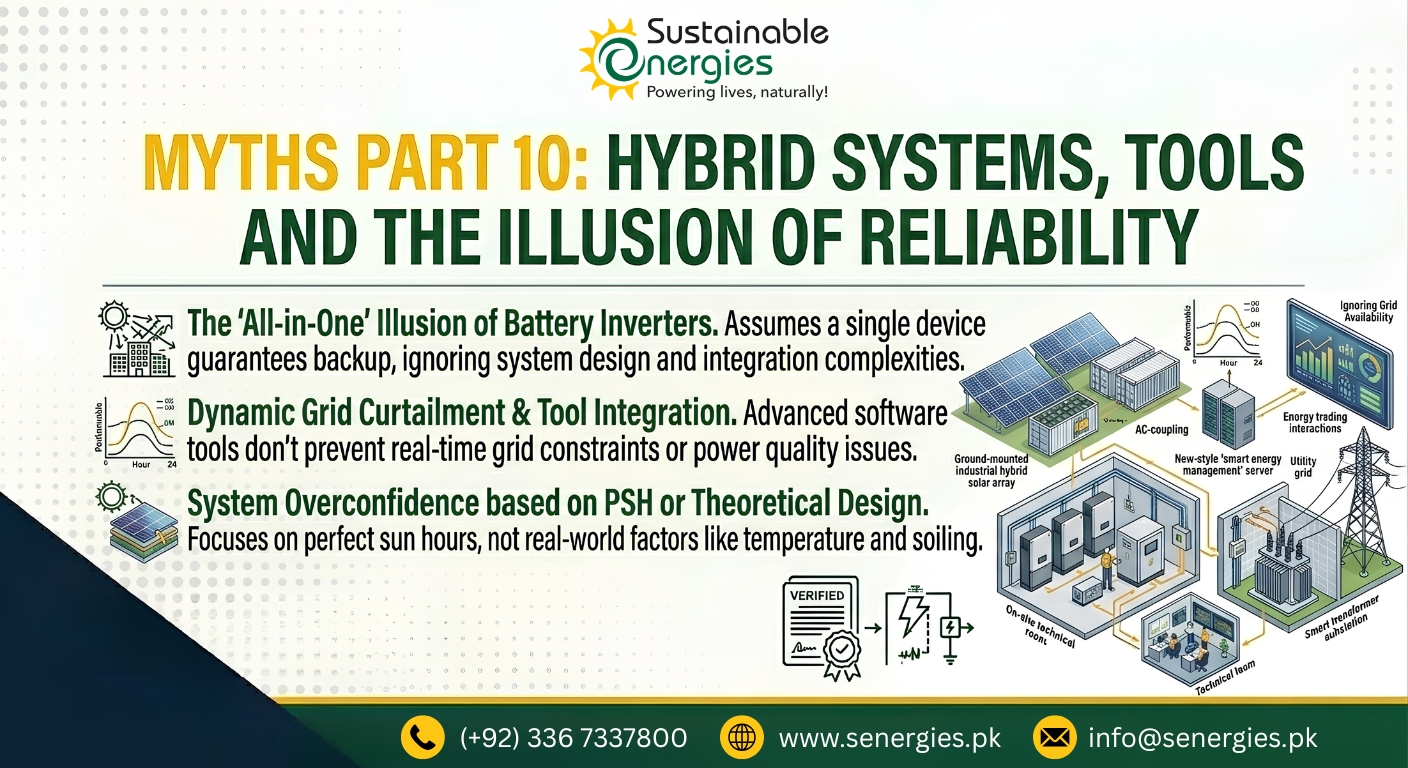
The Hybrid Illusion: Why Vendor Sizing Tools and Redundancy Mislead BESS Design
As solar-plus-storage systems have become more common across Pakistan, confidence in their reliability has grown — sometimes faster than actual technical understanding. Hybrid inverters, packaged Energy Storage Solutions (ESS), and automated sizing tools are frequently presented as complete, definitive answers rather than basic engineering starting points.
This article addresses a critical class of BESS myths: the false belief that hybrid systems are inherently robust due to multiple fallbacks, the assumption that vendor sizing tools represent “validated engineering,” and the dangerous comfort of accepting a familiar hardware number without understanding the underlying calculations.
Myth 1: “Hybrid systems don’t fail — they always have a fallback”
The Misunderstanding
Hybrid configurations are often marketed with an air of absolute certainty: “You have solar, a battery bank, the grid, and a backup generator — so system failure is virtually impossible.” Commercial teams frequently mistake massive system redundancy for genuine operational reliability.
The Reality: Redundancy changes failure modes, it doesn’t remove them
While having multiple power sources is beneficial, hybrid assets still experience critical dropouts. Failure points emerge when:
In a hybrid setup, system failure is rarely catastrophic or sudden; it is a gradual, cumulative depletion. The asset appears perfectly functional on the dashboard until recovery limits are crossed, leaving the site stranded during the next outage.
Myth 2: “If the vendor sizing tool approves it, the design is safe”
The Misunderstanding
Many procurement teams and EPC engineers rely blindly on manufacturer web calculators, pre-configured vendor spreadsheets, and basic training templates provided alongside hardware. These tools are treated as authoritative, bulletproof design validation.
The Reality: Most tools are strictly scenario-limited
Manufacturer software packages are inherently optimized to demonstrate feasibility, accelerate B2B sales conversations, and eliminate upfront design friction. To do this, they apply severe technical shortcuts:
Vendor applications are commercial feasibility tools — they are not thorough engineering failure-analysis engines.
Myth 3: “If the final number looks right, the method must be right”
The Misunderstanding
When a rough sizing exercise yields highly familiar hardware brackets — such as a standard 250 kWp solar array paired with a familiar 500 kWh battery block — engineering confidence rises instantly. The assumption is that because the destination looks normal, the methodology must be sound.
The Reality: Correct numbers can be reached for the wrong reasons
Familiar hardware results often occur because experienced designers subconsciously build in oversized safety margins or let ideal summer data dominate their calculations. However, the sizing framework itself remains fragile. A solar-plus-storage design that cannot transparently explain exactly how it survives winter under stress is not a robust design — even if the final equipment list looks sensible on paper.
The Core ESS Illusion: The most dangerous baseline belief in storage engineering is: “If the cumulative energy balances out on a spreadsheet, battery recovery will take care of itself.” This completely ignores physical inverter power limits, strict time domain constraints, charge tapering curves at high SoC, and progressive multi-day State of Charge (SoC) drift. Energy volume alone does not guarantee a successful recharge cycle.
The Anatomy of a “Quiet” Storage Failure
Unlike traditional mechanical infrastructure where a failure results in a loud component break, battery energy storage systems fail quietly. To an untrained operator, an engineered deficit looks like:
Nothing technically triggers an alarm. Your built-in design margins simply disappear over time. By the time the asset failure becomes obvious to the end-user, the battery chemistry is already heavily compromised.
The Reality-Check Question for Industrial EPCs
To expose a weak or superficial storage proposal, ask the design team one simple question: “After experiencing a deep discharge sequence during the worst weather month of the year, can this configuration fully recover its State of Charge before the next scheduled or unscheduled grid outage?”
If their answer relies on annual regional averages, best-case summer days, or highly optimistic software defaults, then your operational reliability is being assumed rather than engineered. Shortcut assumptions survive in the market because they reduce upfront engineering design effort and align with quick sales narratives, but convenience cannot deliver winter resilience.
Conclusion: Redefining the Role of Solar Sizing Tools
Hybrid inverters and automated vendor tools are incredibly valuable assets when positioned correctly within a project layout. They should be utilized as initial starting points, fluid scenario evaluators, and visual communication aids for clients. However, automated calculators must never become a permanent substitute for raw engineering judgment.
Hybrid setups do not eliminate operational risk; they distribute it across a wider web of electrical variables. Only commercial designs that explicitly manage moving timelines, power boundaries, charge recovery states, and worst-case weather conditions can deliver on the true promise of energy autonomy.