
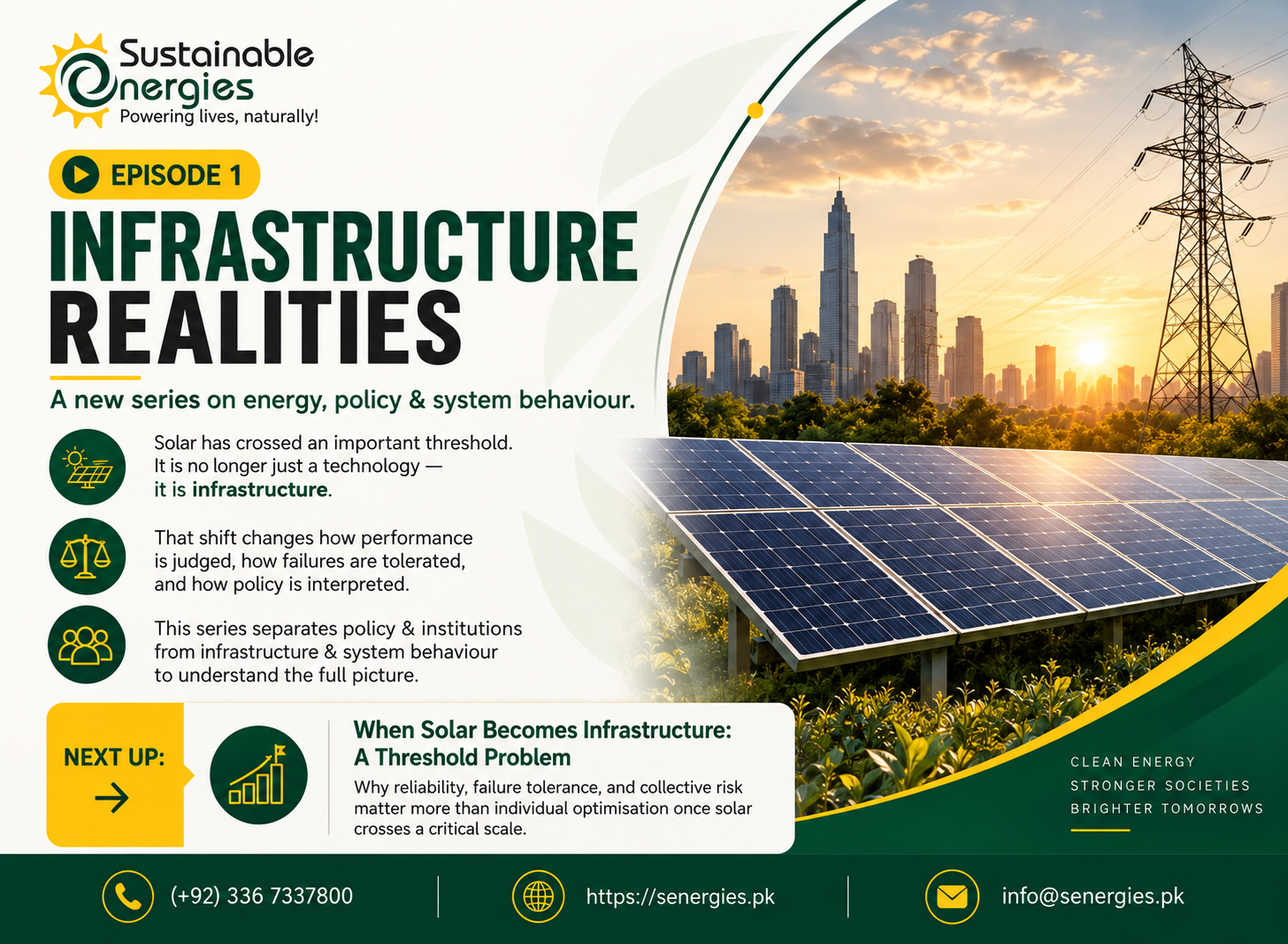
Why Energy Discussions So Often Go Nowhere
Discussions around solar and energy policy in Pakistan tend to be intense, repetitive, and rarely productive.
The same themes resurface again and again:
Yet despite the volume of commentary, genuine understanding remains limited.
One reason is that energy conversations often mix three different things without distinction:
When these are blended together, disagreement becomes inevitable — not because people disagree on facts, but because they are often talking about different layers of the system.
The Shift That Changed Everything
For a long time, solar was treated as a technology:
That framing is no longer accurate.
Grid-tied solar has crossed a threshold.
It now influences:
Once a technology reaches that point, it stops behaving like a gadget and starts behaving like infrastructure.
Infrastructure is different:
Many misunderstandings around solar policy arise because this shift has not been fully acknowledged.
Two Lenses Are Required — Not One
To understand energy systems at this stage, two distinct lenses are necessary.
Lens 1: Policy & Institutions
This lens asks:
This is not about agreement or disagreement. It is about structure.
Lens 2: Infrastructure & System Behaviour
This lens asks:
This is not about documents. It is about outcomes.
Most confusion appears when only one lens is used to explain problems created by both.
What This Series Will Do
This series treats solar and energy systems as infrastructure, not ideology.
It will:
Where interpretation is required, assumptions will be stated explicitly.
What This Series Will Not Do
This series will not:
Opinions, where offered, will be clearly labelled as engineering or economic perspectives, not prescriptions.
Who This Series Is For
This series is written for:
It is not written for activism, outrage, or casual consumption.
A Closing Anchor
Energy systems are constrained systems.
Understanding those constraints — technical, financial, and institutional — matters more than slogans, averages, or isolated success stories.
This series exists to build that understanding.