
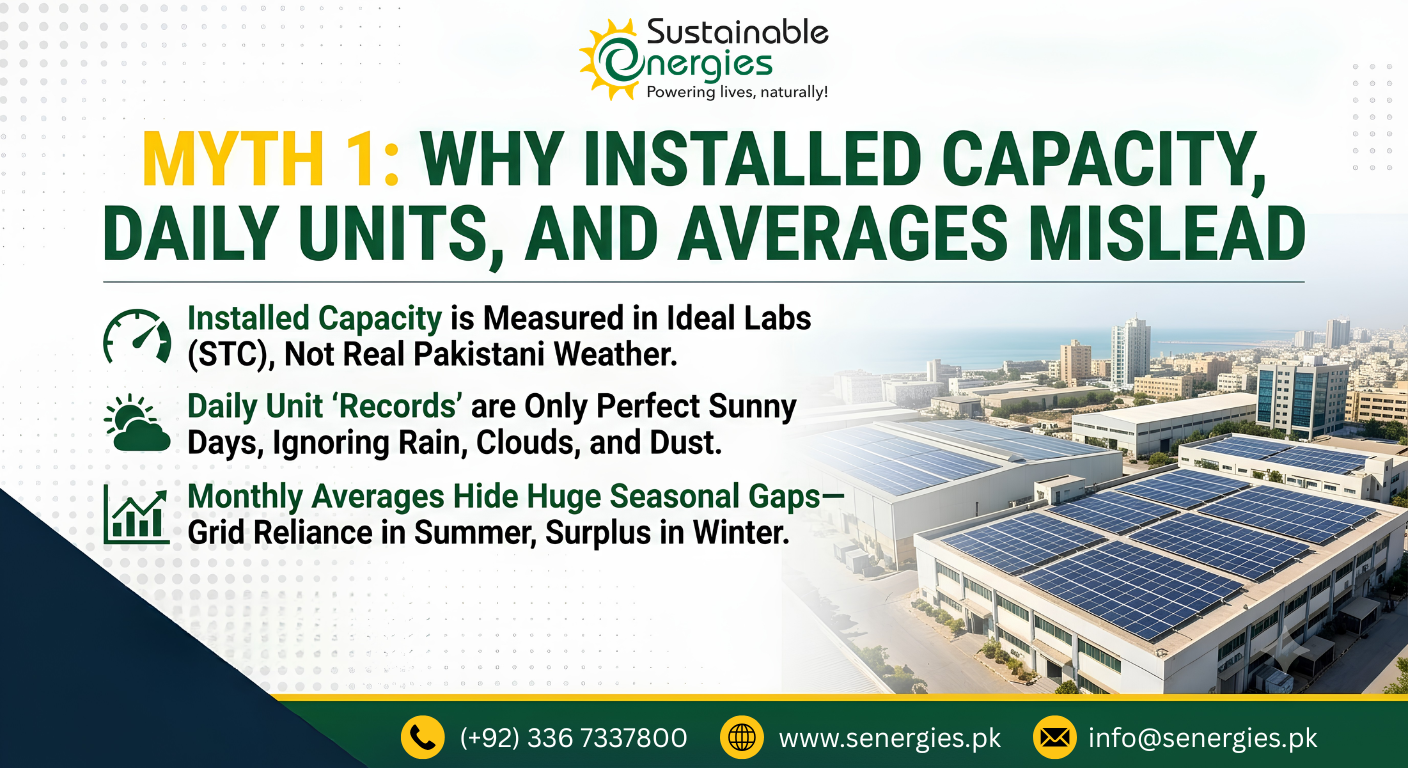
Foundational Solar PV Misconceptions: 3 Rules of Thumb & Sizing Myths
The solar PV industry has grown rapidly, bringing with it a set of commonly repeated “rules of thumb.” Many of these rules are not entirely wrong — but they are incomplete, misapplied, or taken too literally.
This article addresses some of the most foundational misconceptions in solar engineering:
These misunderstandings are responsible for a large portion of disappointment, mistrust, and misdiagnosed underperformance in real commercial and residential projects.
Myth 1: “kW and kWh are basically the same thing”
The Misunderstanding
Installed system size (kW) is often used interchangeably with energy production (kWh). Statements like “We installed a 100 kW system, so it should give 400 units per day” are extremely common — and fundamentally flawed.
The Reality: Power and energy are different quantities
A PV system’s kW rating tells you how big it is, not how much energy it will produce. Actual energy generation depends on:
Confusing the two metrics leads directly to unrealistic financial and performance expectations.
Myth 2: “1 kWp gives 4 kWh per day”
Why this myth persists
This simple ratio is easy to remember, appears to work “on average,” and is repeated so often in the local market that it gains unwarranted authority. However, it is not an absolute physical constant.
Where the number actually comes from
“4 kWh per kWp per day” is merely a rough annual average derived from local solar irradiance expressed as Peak Sun Hours (PSH). It is a statistical convenience for back-of-the-envelope estimations, not a formal generation guarantee.
Why it fails in practice
Solar irradiance is highly variable:
While some peak summer months will comfortably exceed this value, winter months will fall well below it. Using an annual average as a rigid design anchor is incredibly risky for critical or captive power systems.
Myth 3: “Peak Sun Hours are usable operating hours”
The Intuitive Mistake
Peak Sun Hours (PSH) are frequently misinterpreted to mean: “The system runs at full peak power for exactly X hours continuously.” This is a fundamental misunderstanding of solar physics.
The Reality: PSH are an energy abstraction
PSH simply mathematically compresses the total area under the daily solar irradiance curve into a single, convenient numeric abstraction. They do not imply flat irradiance, constant peak power, or uniform conversion efficiency throughout the day.
Morning and late evening sunlight is significantly less productive for power generation due to:
In short: Not all insolation contributes equally to usable electrical energy.
Myth 4: “If output is low, the system underperformed”
Why this conclusion is tempting
Energy yield (kWh) is highly visible on monitoring apps and very easy to compare. Actual conversion efficiency, however, is not. Therefore, whenever daily or monthly kWh drops, the immediate human reaction is: “Something must be technically wrong with the solar plant.”
The Reality: Performance must be normalised
A solar system can physically produce less energy and still perform perfectly if the available solar resource (sunlight) was proportionally lower due to weather. This is exactly why the **Performance Ratio (PR)** exists.
Why Performance Ratio (PR) matters
PR answers the core engineering question: How efficiently did the system convert the actual available sunlight into usable electrical energy?
Without tracking and calculating PR, it is completely impossible to judge plant performance objectively.
Why these myths matter
Taken together, these basic misunderstandings lead to highly inflated expectations, incorrect fault diagnoses, misplaced blame on hardware or EPC contractors, and poor up-front system design decisions. Ultimately, they erode technical trust between clients and solar professionals.
A better way to think about PV systems
Instead of asking simplistic questions like “How many units should this system give me today?”, industry decision-makers should ask:
“How much sunlight was actually available, and how efficiently did the system convert it?”
This fundamental mental shift — moving away from rigid averages and focusing strictly on operational context — is the true foundation of professional PV engineering.
Closing Thought
Solar systems do not operate on arbitrary rules of thumb. They operate strictly on physics, time, and environmental variables. Rules of thumb are helpful for quick approximations, but only when their strict technical boundaries are fully understood and respected.
“How many units should this system give?”
Ask:
“How much sunlight was available, and how well did the system convert it?”
This shift — from averages to context — is the foundation of good PV engineering.