
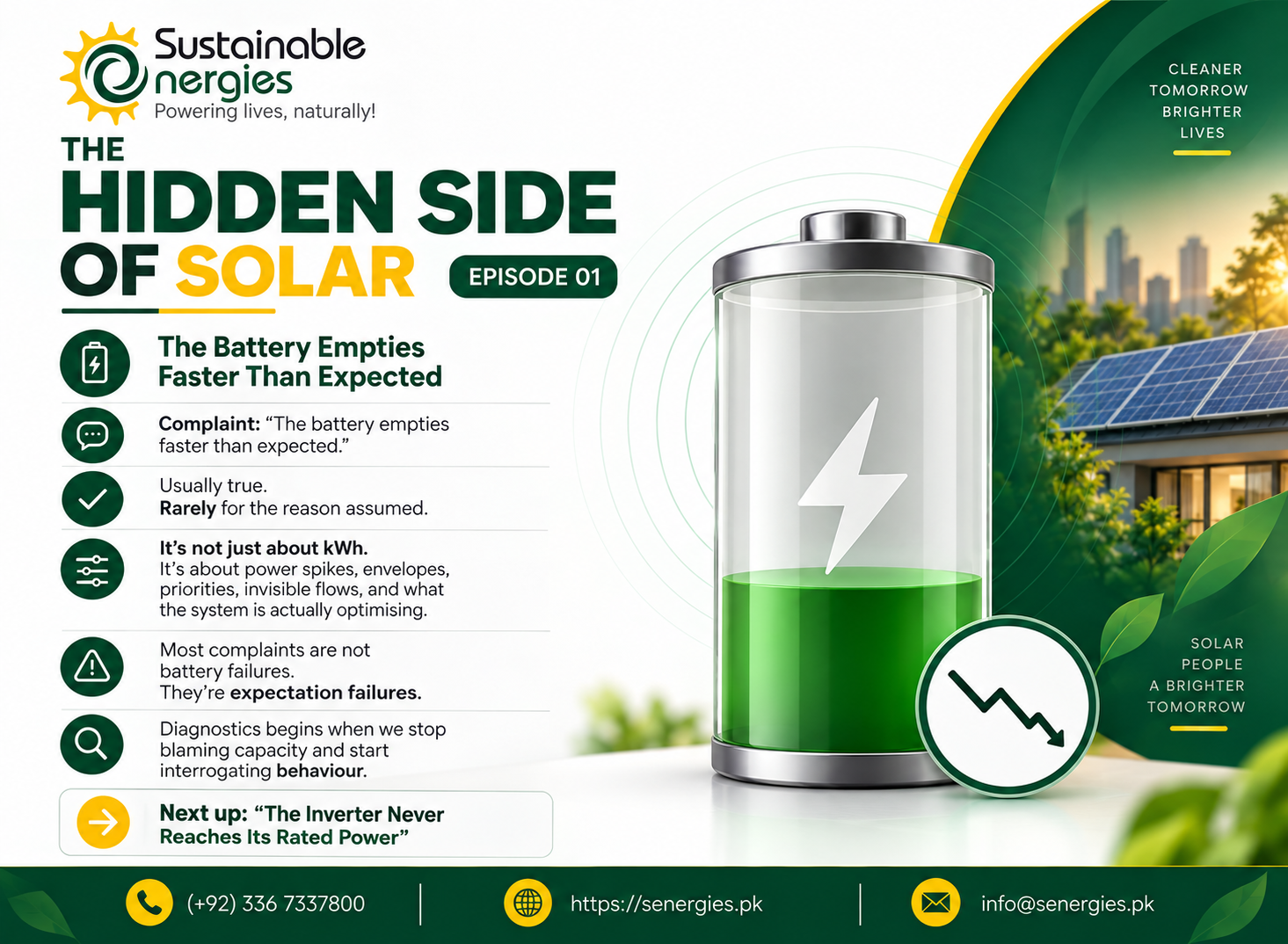
Few complaints are as common—or as confidently stated—as this one:
“The battery empties much faster than expected.”
It is usually followed by a number:
The math feels simple. The reality rarely is.
The mistake is not arithmetic. It is assuming the system was ever operating under the conditions implied by the calculation.
This symptom cannot be understood by looking at the battery alone. It requires stepping through the system layer by layer.
Applying Diagnostic Reasoning
Step 1: Clarify the claim (before explaining it)
The first diagnostic mistake is accepting the complaint at face value.
“The battery empties faster” can mean very different things:
Before reasoning, the system-literate question is:
Compared to what operating assumption?
Most expectations implicitly assume:
None of these are guaranteed.
Step 2: Separate power from energy (again, on purpose)
Most “five-hour” expectations silently assume:
In practice:
A battery can be energy-sufficient but power-constrained, or power-capable but energy-limited —sometimes within the same hour.
If power demand spikes intermittently, energy drains faster than the average suggests.
Step 3: Identify active envelope limits
Batteries do not operate at a single point. They operate inside envelopes shaped by:
As SoC drops, many systems:
From the outside, this looks like:
From the inside, the system is preserving itself.
Step 4: Check for invisible energy flows
One of the most common blind spots is assuming all battery discharge goes to the load.
In reality, energy may also be:
If CT placement or portal logic hides internal flows, the user sees only the result—not the cause.
Energy that never appears at the load is still energy that left the battery.
Step 5: Examine control priorities, not hardware size
Many battery systems are not designed to “maximise runtime.” They are designed to:
When objectives conflict, runtime usually loses.
A system that exits battery mode early may not be failing—it may be successfully obeying a higher-priority rule.
Unless that hierarchy is understood, the behaviour feels arbitrary.
Step 6: Re-evaluate the measurement window
Short observation windows exaggerate disappointment.
A one-hour snapshot during:
does not represent the system’s energy capability.
Likewise, daily energy totals can hide short, intense discharge periods that dominate battery depletion.
Before concluding anything, ask:
Over what time window does this complaint remain true?
What this symptom actually teaches
“The battery empties faster than expected” is rarely a battery problem.
It is usually a model mismatch:
Once the system is interrogated through envelopes, priorities, and visibility, the behaviour often becomes predictable—even if still undesirable.
And that distinction matters.
A predictable limitation can be redesigned around.
An imagined failure cannot.