
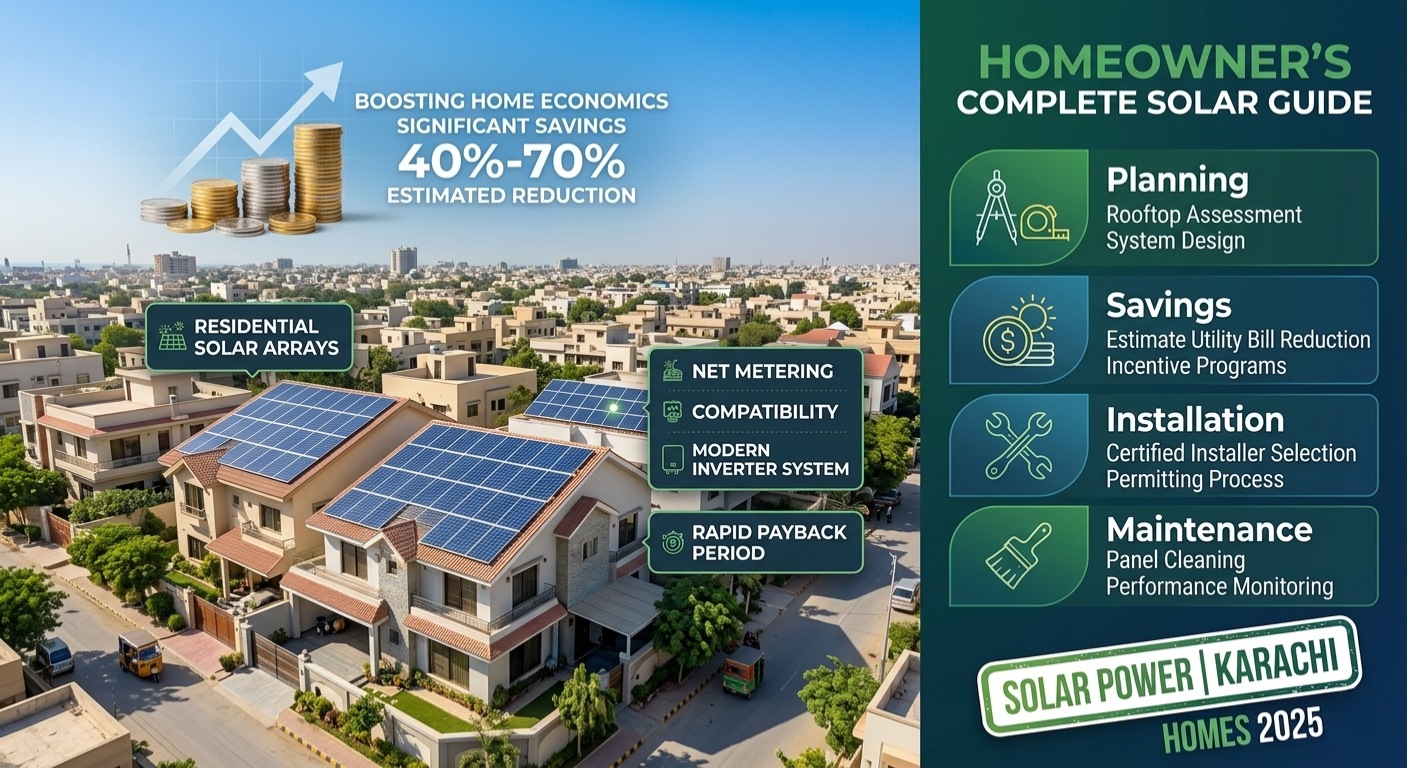
Getting solar panels installed at home in Karachi feels like a big decision — and it is. You’re committing to infrastructure that will sit on your roof for 25 years, affect your electricity bills from month one, and either work brilliantly or frustrate you depending on how it was designed and installed.
This guide walks you through everything a Karachi homeowner needs to know before signing anything: how systems are sized, what realistic costs look like in 2025, what the installation process involves, and how to avoid the mistakes that lead to underperforming systems.
Step 1: Understand Your Actual Power Consumption
The single most important number in solar sizing is your average monthly electricity consumption in kilowatt-hours (kWh). You’ll find this on your K-Electric bill — look for the “Units Consumed” figure.
For residential properties in Karachi, typical consumption ranges are roughly:
- Small apartment (2 bed, basic appliances): 300–600 kWh/month
- Medium home (3–4 bed, 1–2 ACs): 700–1,200 kWh/month
- Large home (4+ bed, multiple ACs, pool): 1,500–3,000+ kWh/month
A common mistake is sizing a solar system based on what you wish your bill was, rather than what it actually is. If your home consumes 1,000 kWh per month and you install a system sized for 600, you’ll still have a significant K-Electric bill and feel cheated by solar when it was really a sizing problem.
Look at 12 months of bills if possible, not just the most recent one. Electricity consumption in Karachi spikes dramatically in summer (June–September) when air conditioning runs around the clock, and drops in winter. A good solar design accounts for this seasonal variation.
Step 2: Know Your System Options
There are three main types of solar systems for homes in Karachi. Each serves a different need and budget.
On-grid (grid-tied) system
Connects directly to the K-Electric grid. Your solar panels generate power during the day; any surplus is exported to the grid under the net metering or net billing framework. At night, or when panels aren’t producing enough, you draw from the grid as normal.
Best for: Homes with reliable grid access and consistent daytime electricity usage (home offices, businesses run from home, large appliance loads during the day).
Limitation: Provides no backup during power cuts. If the grid goes down, your solar system also shuts off for safety reasons.
Hybrid (solar + battery) system
Combines solar panels with a battery bank and a hybrid inverter. Surplus solar power charges the batteries. During a grid outage, the inverter switches to battery power and keeps selected loads running.
Best for: Most Karachi homeowners. Given the frequency of K-Electric outages, having battery backup transforms the experience of owning solar. You’re not just saving on bills — you’re also eliminating the disruption of load-shedding.
Cost note: Batteries add significantly to upfront cost but the value in Karachi’s context is real and measurable. A home that previously spent PKR 25,000/month on a generator will recover battery costs quickly.
Off-grid system
Fully disconnected from the grid. Solar and batteries supply everything. Only suitable for properties with no grid connection, or for specific outbuildings and farm installations.
Step 3: Understand Realistic Costs in 2025
Solar prices in Pakistan have changed significantly over the past two years. Panel prices dropped sharply in 2023–2024 as Chinese manufacturing scaled up, but inverter and battery costs remain the dominant expense for hybrid systems.
As a rough guide for Karachi in 2025:
|
System Type |
Capacity |
Approximate Cost (PKR) |
|
On-grid |
5 kW |
700,000 – 900,000 |
|
On-grid |
10 kW |
1,200,000 – 1,600,000 |
|
Hybrid (without batteries) |
5 kW |
900,000 – 1,200,000 |
|
Hybrid (with battery backup) |
5 kW + 10 kWh storage |
1,500,000 – 2,200,000 |
|
Hybrid (with battery backup) |
10 kW + 20 kWh storage |
2,800,000 – 4,000,000 |
These are indicative ranges. Final pricing depends on panel brand and wattage, inverter model, battery chemistry (lithium vs lead-acid), mounting structure, cabling, and installation complexity.
Be cautious of prices that fall significantly below these ranges — they almost always mean compromises on component quality, workmanship, or warranty terms.
Step 4: Evaluate Rooftop Suitability
Not every roof is equally suitable for solar in Karachi. An installer should assess:
Orientation. South-facing rooftops receive the most direct sunlight in Pakistan throughout the year. East or west-facing panels produce about 15–20% less. North-facing panels are significantly less efficient.
Shading. Water tanks, overhead cables, neighbouring buildings, and trees can shade panels for part of the day. Even partial shading on one panel can reduce the output of an entire string if the system isn’t designed to handle it. Modern microinverter and power optimizer setups mitigate this, but require a higher upfront investment.
Structural integrity. A standard residential solar installation adds roughly 10–15 kg per square metre to your roof. Older slab roofs should be assessed for load-bearing capacity, especially for larger systems.
Available area. A 5 kW system typically requires 25–35 square metres of unobstructed rooftop space.
Step 5: Know What a Turnkey Installation Includes
A professional turnkey solar installation covers the complete process from design to handover. This should include:
Site visit and energy audit
System design and yield modelling
Supply of all equipment (panels, inverter, mounting structure, cables, protection devices)
Civil work and mounting structure installation
Electrical installation and wiring
System commissioning and testing
Net metering application support (for grid-tied and hybrid systems)
Handover documentation and monitoring setup
Warranty and after-sales support terms
If a proposal omits any of these elements without explanation, ask why. Some companies quote a low headline price and charge separately for civil work, metering, or monitoring — bringing the real cost closer to a full-service quote but with less accountability.
Step 6: What Happens During Installation
A residential solar installation in Karachi typically takes 2–4 days for a standard home system. Here’s the general sequence:
Day 1: Civil team installs the mounting structure on the roof. This involves drilling into the slab or parapet walls to fix the racking system. The structure is typically galvanised steel or aluminium.
Day 2: Solar panels are fixed to the mounting structure and connected in strings. DC cabling is run from the rooftop down to the inverter location (typically a shaded wall near the main distribution board).
Day 3: Inverter, battery bank (if applicable), and protection devices are installed. DC and AC connections are made and the system is tested in isolation before connecting to the household wiring.
Day 4 (or same as Day 3): Final commissioning, system handover, walkthrough with the homeowner, and submission of net metering application documentation if required.
Choosing the Right Solar Installer in Karachi
Karachi’s solar market has expanded rapidly and, alongside excellent installers, now includes a number of companies with limited technical experience and no meaningful after-sales presence.
When evaluating installers, look for:
Track record and years in operation. A company that has been installing solar in Karachi for a decade has seen systems through summers, monsoons, and dust storms — and has refined its methods accordingly.
Portfolio and references. Ask to see similar residential projects and, where possible, speak to existing customers.
Warranty terms. Panel performance warranties of 25 years are standard for Tier-1 products. Inverter warranties of 5–10 years are typical. Labour warranties of 1–2 years are reasonable. Be wary of vague or unwritten warranty commitments.
Maintenance support. Solar systems require periodic cleaning and annual technical inspection to maintain performance. Does your installer offer this, and at what cost?
Sustainable Energies Enterprise has been installing residential solar systems across Karachi since 2012. We conduct a thorough energy audit and site assessment before every project, design systems matched to your actual consumption, and support every installation with long-term maintenance services.
If you’re ready to take the first step toward energy independence for your home, our team is ready to help — with no hard sell and no shortcuts.
Get in touch with SEE for a free home assessment.
Sustainable Energies Enterprise — Bahadurabad, Karachi | info@senergies.pk | (+92) 336 7337800