
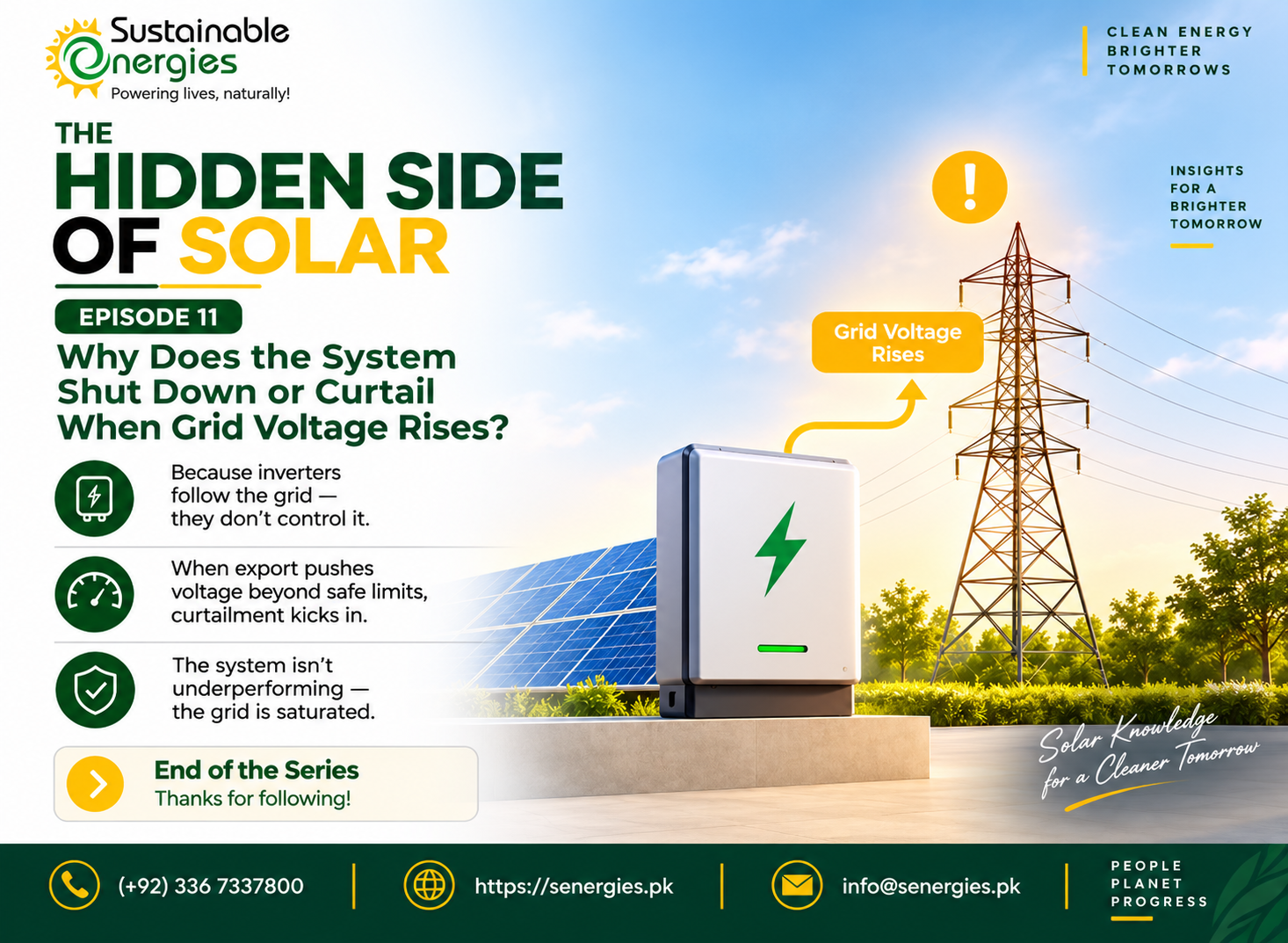
A familiar complaint — especially in high solar penetration areas:
“The system shuts down or reduces output when grid voltage rises. Why can’t it just keep producing?”
From the user’s perspective, the sun is available, the system is capable, and the grid is still energised. Curtailment feels unnecessary — even wasteful.
But this behaviour is rarely arbitrary.
It is the system responding to voltage conditions beyond its safe operating envelope.
Applying Diagnostic Reasoning
Step 1: Understand that inverters are grid-following devices
Most grid-tied inverters do not set grid voltage — they follow it.
They synchronise with existing grid conditions and must operate within defined voltage and frequency limits to remain connected.
If grid voltage rises beyond acceptable thresholds, the inverter cannot safely inject additional power.
Instead, it must:
This is compliance behaviour, not equipment limitation.
Step 2: Examine how voltage rise occurs
Voltage rise is driven by power flow direction.
When solar systems inject power into local distribution lines:
In areas with high solar penetration or weak distribution infrastructure, this effect becomes pronounced — especially during peak generation periods.
The grid becomes less able to absorb additional generation without exceeding voltage limits.
Step 3: Identify hosting capacity constraints
Every distribution network has a finite ability to absorb distributed generation — known as hosting capacity.
When local generation approaches or exceeds this capacity:
The inverter is not limiting itself arbitrarily — it is respecting the hosting limits of the infrastructure it is connected to.
Step 4: Recognise inverter protection envelopes
Inverters include built-in voltage operating windows defined by:
When voltage exceeds these windows, curtailment or shutdown protects:
Operating outside these envelopes would risk damage or grid disturbance.
Step 5: Consider temporal clustering effects
Voltage rise often occurs under coincident conditions:
When generation exceeds local consumption, export pressure intensifies — pushing voltage upward.
This is why curtailment may appear time-specific rather than continuous.
Step 6: Reframe the behaviour
From a system perspective, shutdown or curtailment is not underperformance.
It is infrastructure interaction.
The inverter is signalling:
The system is not failing to produce — it is being prevented from delivering.
What this symptom actually teaches
Solar performance does not depend solely on irradiance and hardware capability.
It depends on the grid’s ability to receive generation.
When hosting capacity is constrained, production must yield to infrastructure stability.
Curtailment in this context is not waste — it is grid protection in action.