
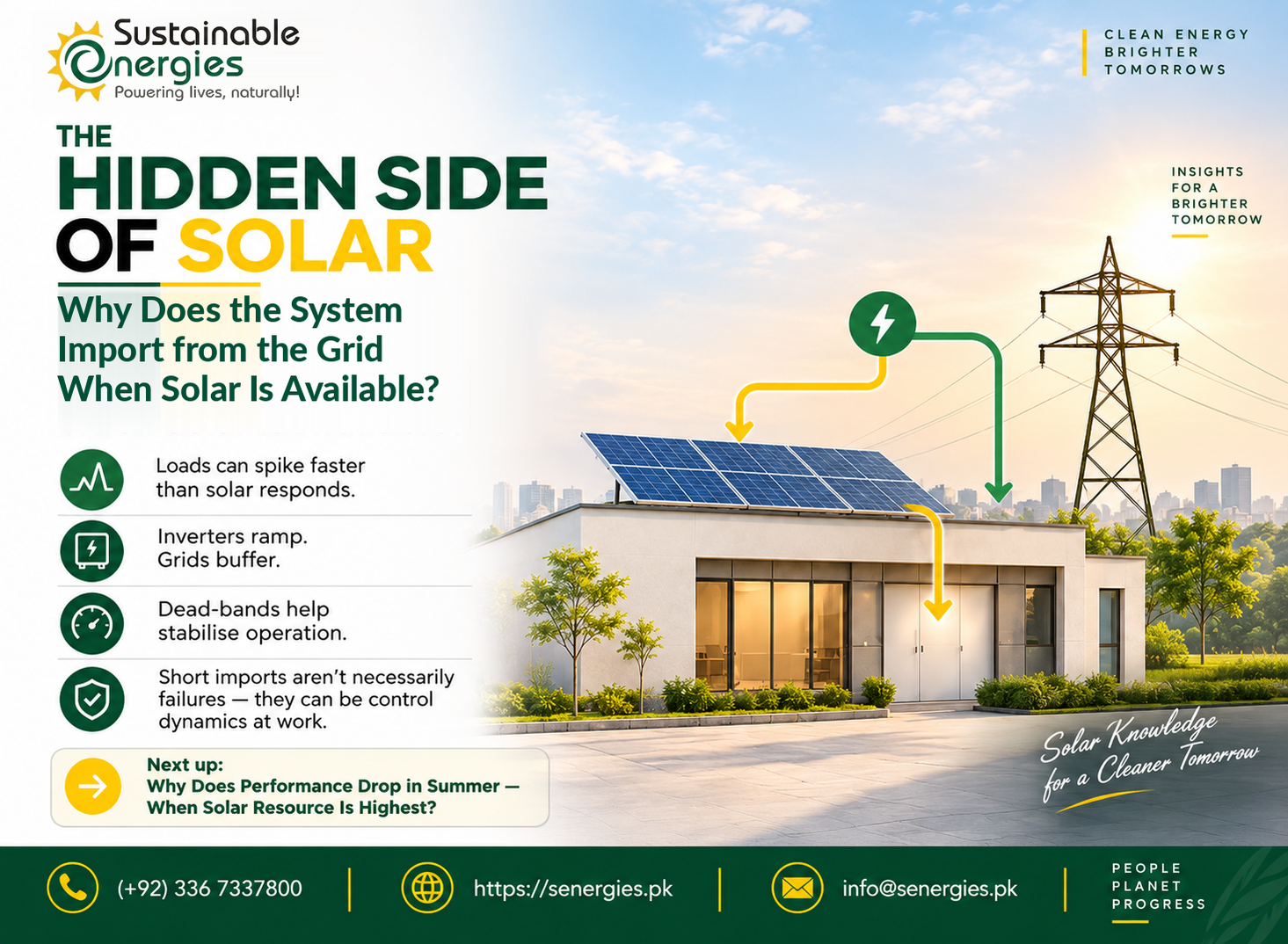
A common observation — often accompanied by screenshots:
“The system is importing from the grid even though solar is producing. Why isn’t solar covering the load?”
To the observer, this feels like wasted opportunity. If generation exists, import should not.
But real systems do not operate on static snapshots. They operate on dynamic balance, continuously adjusting supply and demand.
Import during solar production is not necessarily an error. It is often a reflection of control response boundaries.
Applying Diagnostic Reasoning
Step 1: Examine timing, not just availability
Solar availability does not automatically equate to load coverage at every instant.
Loads change abruptly:
Solar generation, by contrast, changes gradually.
When load demand spikes faster than inverter response can compensate, the grid momentarily supplies the deficit.
This import may last seconds — or fractions of seconds — but still registers in monitoring data.
Step 2: Understand inverter response latency
Inverters do not adjust output instantaneously.
They operate through:
These introduce response latency — typically milliseconds to seconds.
During this interval, the grid acts as a buffer, absorbing mismatches between load and generation.
The system is not failing to respond.
It is responding within control stability limits.
Step 3: Identify control dead-bands
Many systems intentionally maintain small import or export buffers to avoid oscillation.
Dead-bands exist to prevent rapid toggling between import and export states, which could destabilise both the inverter and the grid interface.
As a result:
These buffers improve stability at the cost of apparent precision.
Step 4: Consider measurement resolution
Monitoring portals often exaggerate the visibility of grid interaction.
Short-duration imports may be:
A brief import spike can appear as sustained reliance on the grid when viewed through low resolution data.
Without synchronised high-frequency measurement, import and generation events are easy to misinterpret.
Step 5: Evaluate inverter operating mode priorities
Certain operating modes intentionally allow grid interaction even when solar exists:
In these cases, solar may be allocated elsewhere in the system, leaving the grid to support immediate load demand.
The system is allocating energy strategically — not inefficiently.
Step 6: Reframe the observation
The expectation behind the complaint assumes:
No real system operates under those conditions.
Grid import during solar production is often not a flaw — but a necessary buffer enabling stable, compliant operation.
What this symptom actually teaches
Power systems operate on dynamic equilibrium, not static allocation.
Solar, loads, batteries, and grids interact through response times, buffers, and control hierarchies.
Momentary import during solar production is often:
Understanding this dissolves the perception of inefficiency and replaces it with recognition of system stability mechanisms.