
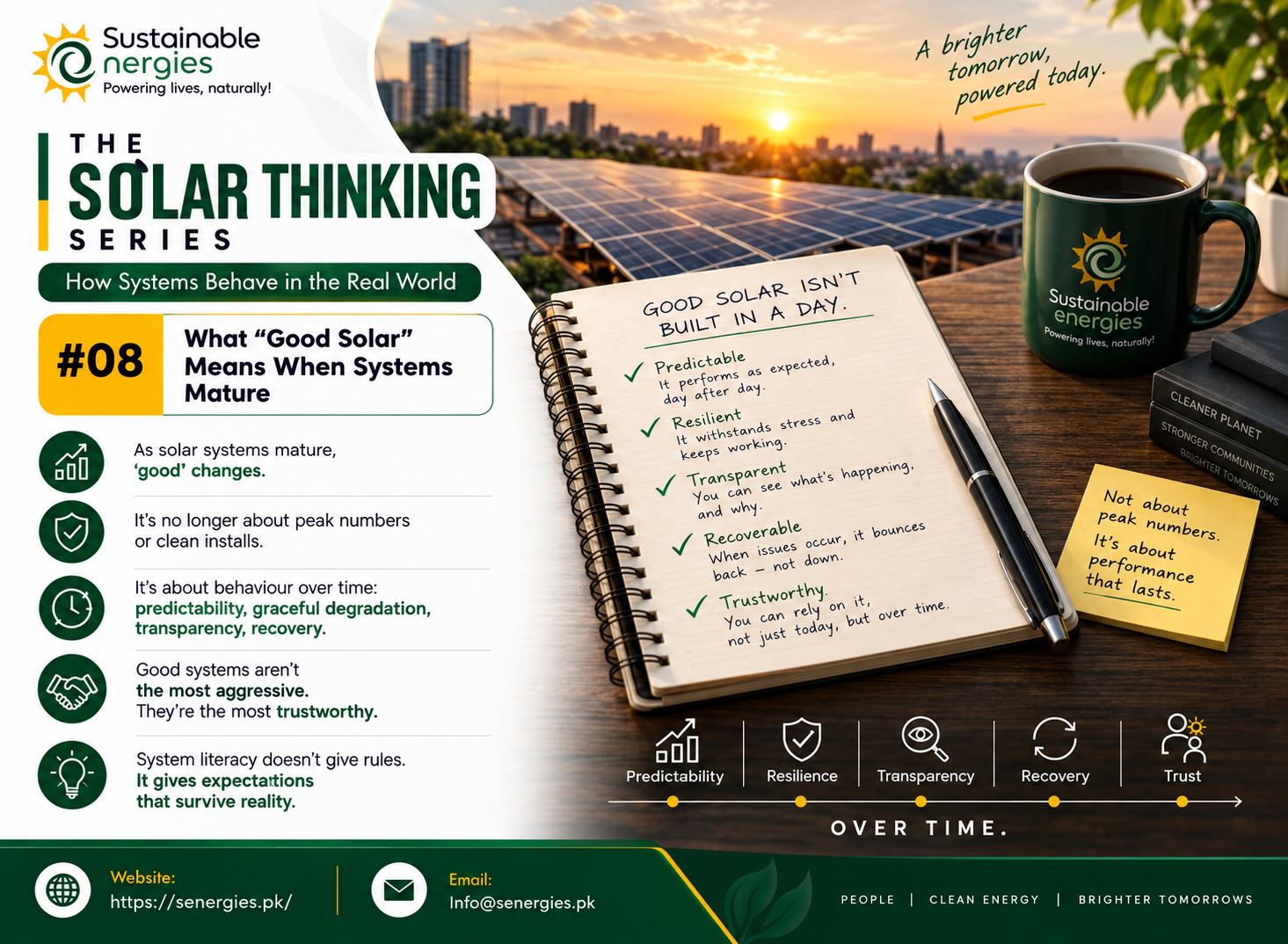
As solar and energy storage systems mature, the definition of “good” quietly changes.
In early adoption phases, success is easy to describe: installation completed, equipment commissioned, expected numbers roughly met. Performance is judged against optimistic baselines, and deviations are tolerated as learning curves.
But as systems scale, integrate, and persist over years, those criteria stop being sufficient.
A system can be installed correctly and still behave poorly.
It can meet averages and still disappoint users.
It can be compliant and still feel unreliable.
This is not because expectations are unreasonable, but because the standard has shifted.
Mature systems are not judged by isolated outputs. They are judged by behaviour over time.
At this stage, “good solar” no longer means:
It means something quieter and more demanding:
In other words, maturity replaces peak performance with trustworthiness.
This series has deliberately avoided prescriptions. There are no checklists here, no “best designs,” no universal rules. That is not a limitation—it is the point. Systems do not fail because rules were ignored; they fail because reasoning was shallow.
Across these articles, several themes repeat:
Taken together, these are not technical tricks. They are ways of thinking.
System literacy is not about predicting every failure or optimising every scenario. It is about forming expectations that remain valid when reality intrudes—when weather deviates, grids misbehave, loads surprise, and data disagrees with intuition.
As solar increasingly becomes infrastructure rather than novelty, this kind of reasoning becomes essential. Infrastructure is not judged by how impressive it looks on good days, but by how it behaves on difficult ones.
The most reliable systems are rarely the most aggressive. They are the ones whose designers understood:
This closing reflection is not an endpoint so much as a reference frame.
From here onward, discussions about performance, diagnostics, upgrades, and failures benefit from a shared language—one grounded in constraints, uncertainty, coordination, and observability.
When expectations are shaped by system behaviour rather than component promise, disappointment decreases, explanations improve, and decisions become calmer and more defensible.
That is what “good solar” looks like when systems grow up