
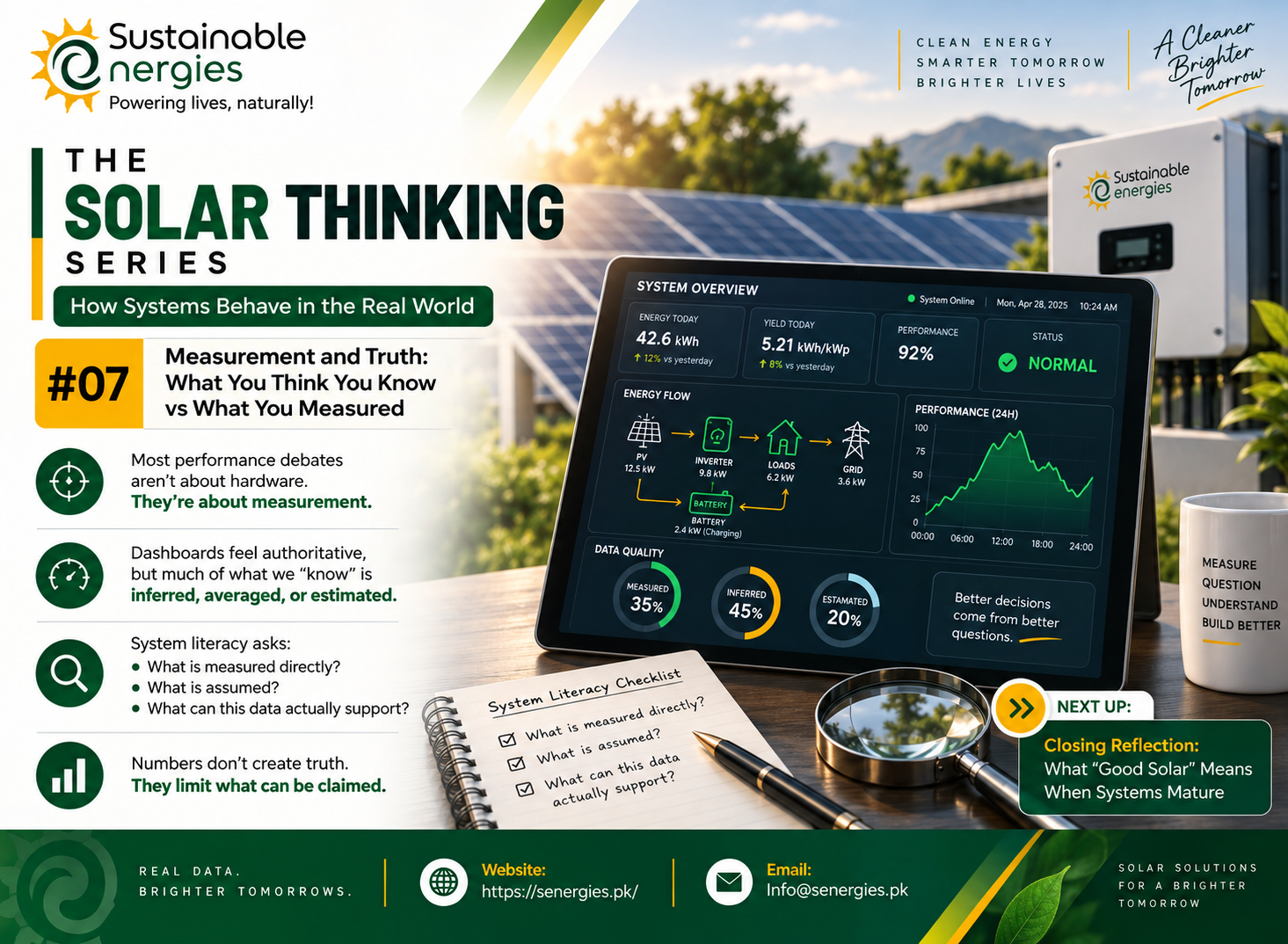
In solar and energy storage systems, disagreements about performance rarely begin with hardware. They begin with measurement.
What is known about a system is shaped not only by what is happening, but by what is being observed, how it is being sampled, and how it is being interpreted. When these layers are weak, confidence becomes detached from reality.
Most systems appear more certain than they actually are.
Portals show clean numbers. Dashboards update smoothly. Daily yields add up neatly. Over time, these outputs are treated as ground truth. But every measurement is a partial view, filtered through sensors, assumptions, and aggregation logic.
System literacy requires recognising a difficult truth:
Most of what we “know” about system performance is inferred, not directly observed.
Consider how easily conclusions form:
Each assumption hides layers of uncertainty.
Measurement systems introduce limits that are rarely acknowledged:
None of this is inherently wrong. These are practical compromises. The problem arises when estimates are mistaken for observations.
This becomes especially visible during disputes:
Often, the disagreement is not about physics—it is about which measurement is trusted, and whether it was ever capable of answering the question being asked.
System literacy shifts the focus from:
“What does the data say?” to: “What can this data actually support?”
This means asking uncomfortable but necessary questions:
Without this scrutiny, measurement becomes narrative. Numbers reinforce expectations rather than challenge them.
There is also a timing dimension. Short observation windows can exaggerate problems. Long aggregation windows can hide them. A system that looks stable over a day may oscillate hourly. A system that looks weak over an hour may perform acceptably over a week. Truth depends on resolution.
This does not imply that better instruments always solve the problem. More data without better questions often increases confusion. What matters is aligning measurement capability with decision intent.
Before trusting a conclusion, system-literate reasoning asks:
When these conditions are not met, confidence should be proportional to uncertainty.
Measurement does not reveal truth automatically. It constrains what can be claimed. Understanding those constraints is not scepticism—it is engineering discipline.