
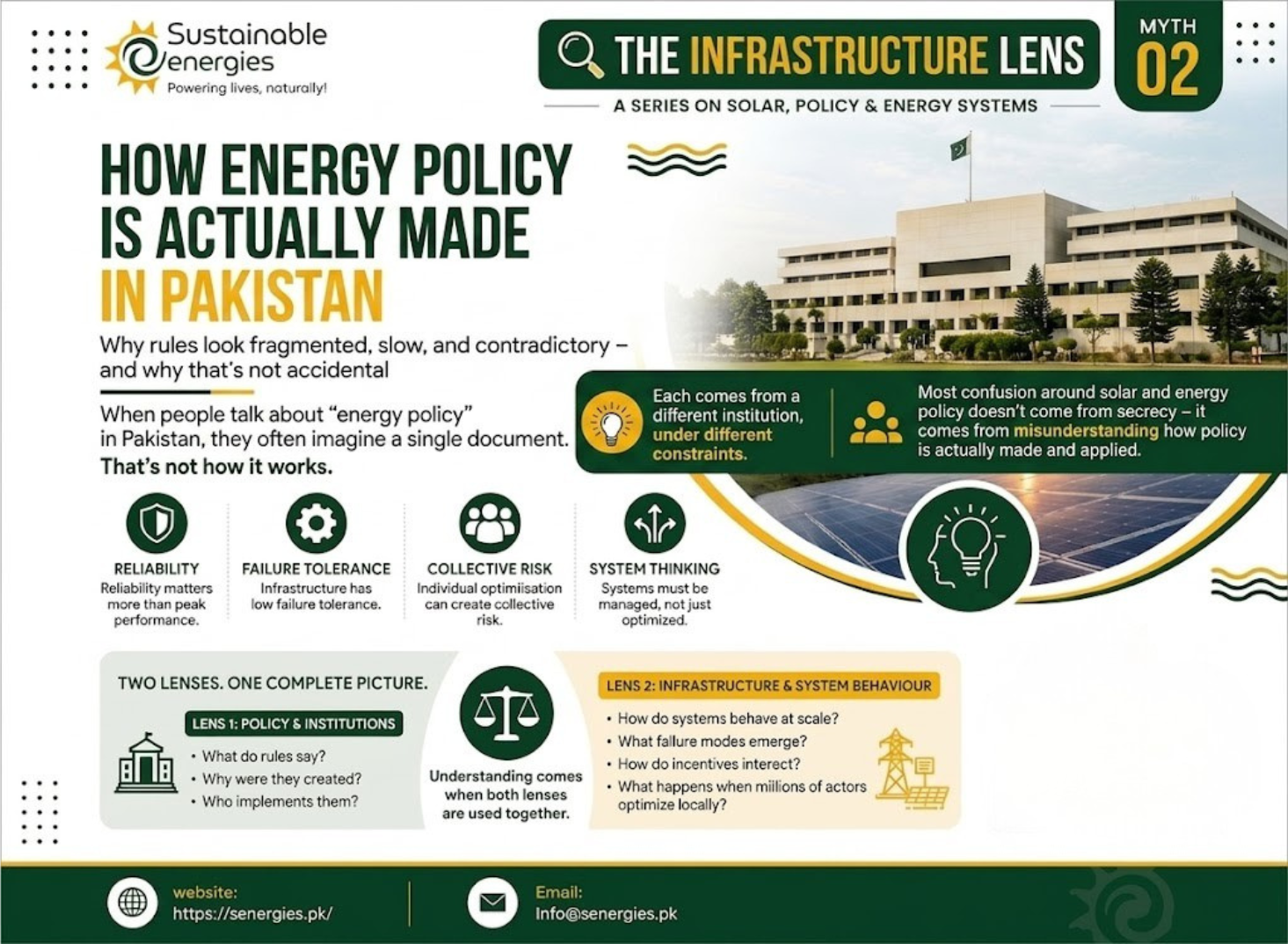
Why Energy Policy Often Feels Confusing
Many discussions around energy policy in Pakistan start from an assumption that policies are clear, singular, centrally designed, and consistently implemented. In reality, none of those assumptions hold.
Energy policy does not exist as one document, written once and applied cleanly. It exists as a layered system of decisions, created by different institutions, at different times, for different constraints. Most confusion arises not because policies are hidden, but because their structure is misunderstood.
The Core Principle: Policy is not a single document—it is a layered, living system of constraints and trade-offs.
Policy Is Not One Thing
When people say “the policy,” they are often referring to very different instruments. In Pakistan’s energy sector, policy is expressed across multiple layers:
Each instrument carries a different legal weight, target audience, lifecycle, and scope. Expecting all of them to align seamlessly at all times is fundamentally unrealistic.
Who Actually Makes Energy Policy?
Energy policy emerges from multiple interacting institutions rather than a single central authority:
Because no single actor controls the entire chain, policy evolves slowly, amendments happen frequently, and execution varies significantly across regions.
Why Policy Design and Implementation Diverge
Policy documents describe intended outcomes, but implementation collides with hard realities: grid limits, technical/non-technical losses, revenue shortfall, capacity obligations, and legacy contracts.
System Reality: When real-world outcomes differ from policy goals, it is rarely due to bad faith—it is almost always a constraint mismatch.
Common Misinterpretations
Public discourse frequently stumbles over three widespread assumptions:
What This Means for Solar and Distributed Energy
For grid-tied solar, this structure is critical. Solar policy never exists in isolation—it directly impacts tariff design, DISCO cash flows, loss recovery, and baseline grid planning assumptions.
Policy adjustments around solar are rarely targeting solar itself; they are institutional reactions to broader grid-level pressures.
Engineering & Economic Perspective
From a technical and market standpoint, energy policy operates much like control logic in a complex machine: feedback loops dictate stability, response lags are inevitable, and system continuity is consistently prioritized over local optimization.
Closing Note
Energy policy is not clean because energy systems themselves are messy, constrained, and path-dependent.
Understanding how policy is structured is the necessary first step toward understanding why outcomes look the way they do.