
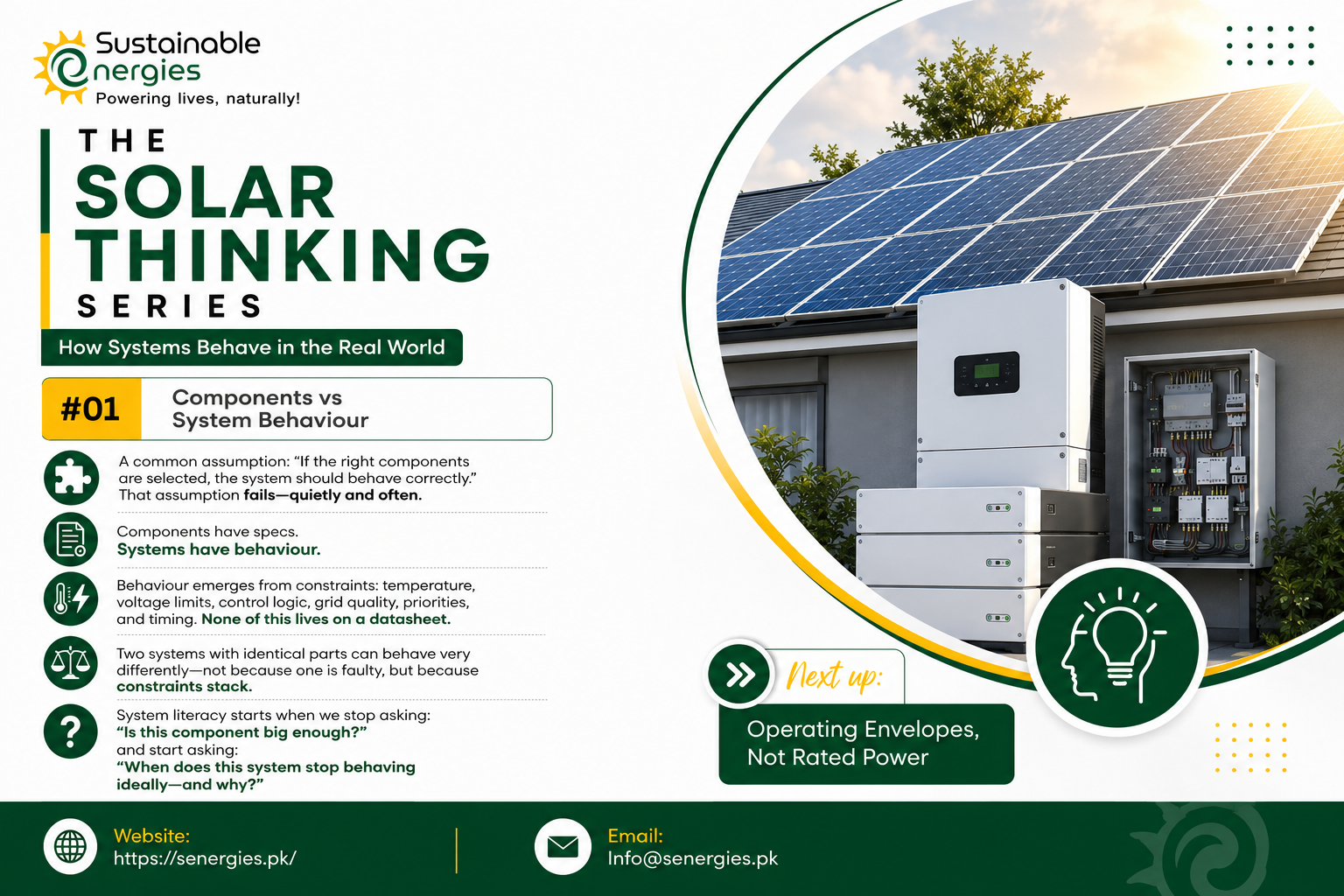
One of the most persistent misconceptions in solar and energy storage is subtle and, therefore, dangerous:
if the right components are selected, the system should behave correctly.
This assumption feels reasonable. After all, engineering begins with components—modules, inverters, batteries, cables, and protection devices. Specifications are reviewed, capacities matched, and safety margins added. On paper, the system appears complete.
And yet, many systems that are “right on paper” behave poorly in practice.
The reason is straightforward but often overlooked:
Systems are not defined by their parts; they are defined by their interactions and constraints.
Components Have Specifications. Systems have behavior.
A component has specifications.
A system has behavior.
Consider a simple example. A PV array may be correctly sized for an inverter. The inverter may be correctly sized for the load. The battery may be correctly sized for backup duration. Each decision, evaluated in isolation, is defensible.
But when these components are connected, new questions emerge:
None of these behaviors appear on a datasheet.
How System Behaviour Emerges
System behavior emerges from constraint stacking. Voltage limits, thermal derating, control hierarchies, grid codes, measurement delays, and user demand all interact. A small limitation in one layer may be irrelevant on its own but decisive when combined with others.
This is why two systems with identical components can perform very differently.
Linear Thinking vs. System Thinking
Component-focused thinking encourages linear reasoning:
Linear Assumption: If A is rated for X, and B is rated for Y, the system should deliver min(X, Y).
System thinking is non-linear:
System Reality: The system delivers whatever remains feasible after all active constraints negotiate—often dynamically and often invisibly.
Why Expectations Often Go Wrong
This distinction matters because many expectations are formed at the component level:
When reality deviates, the explanation often defaults to blame:
In truth, the system may be behaving exactly as its constraints dictate.
Building System Literacy
System literacy begins by replacing component-centric questions with behavioral ones.
Instead of asking, “Is this inverter big enough?” ask:
These questions do not produce single-number answers. They produce operating envelopes—ranges within which performance is predictable and outside which trade-offs appear.
Conclusion
Understanding this shift does not make systems perfect.
But it prevents disappointment from being misdiagnosed as failure.
Before asking whether a system is underperforming, the more fundamental question is
What behavior did we implicitly assume—and was that behavior ever guaranteed?