
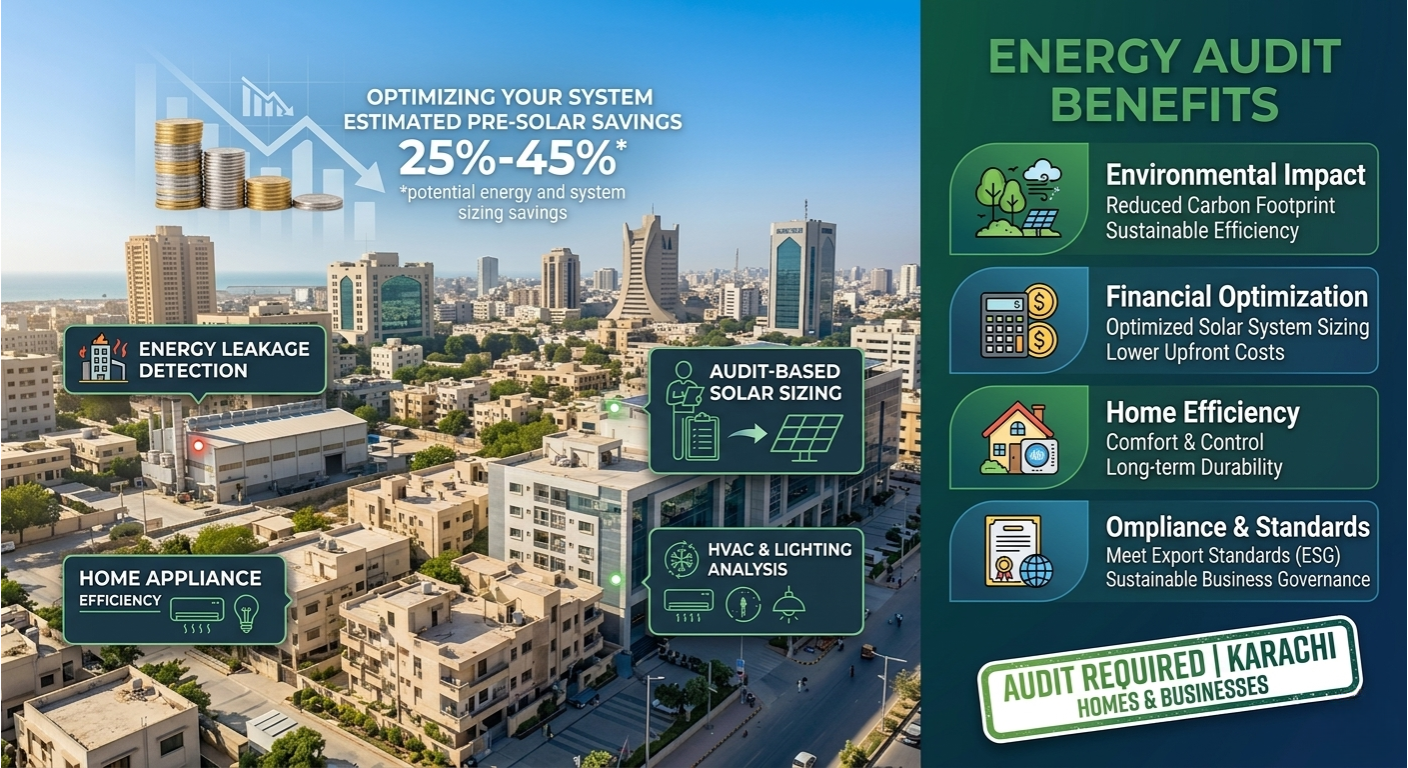
Most people who come to us at SEE already know they want solar. They’ve seen the electricity bills, felt the load-shedding, and decided it’s time to act. What many don’t realise is that the single most important step in getting solar right happens before any panel is ordered or mounting structure installed.
That step is an energy audit.
An energy audit sounds technical — and it is, but in a practical, actionable way. It’s essentially a thorough examination of where your energy is going and how much of it you actually need. Doing this first changes everything about how a solar system should be designed.
What Is an Energy Audit?
An energy audit is a systematic review of a property’s electricity consumption: what loads are running, for how long, at what wattage, and at what time of day. The goal is to build an accurate picture of actual usage rather than relying on average bill figures, which can mask significant variation.
For a home, this means cataloguing every significant appliance — air conditioners, refrigerators, water heaters, washing machines, lighting — along with their running hours and power draw. For a commercial or industrial facility, it extends to production machinery, HVAC systems, server rooms, pumps, compressors, and shift patterns.
The output is a load analysis: a breakdown of where energy is being consumed, when it peaks, and what percentage of total consumption each category represents.
Why an Energy Audit Matters Before Solar
Without an energy audit, a solar installer is essentially guessing. They’ll look at your average monthly bill and estimate a system size. This is how most installations in Pakistan are designed — and it’s why so many solar system owners are disappointed with their results.
Here’s what a proper load analysis reveals that a billing average cannot:
Peak vs. off-peak consumption patterns. Solar panels generate power from roughly 7am to 5pm, with a peak between 10am and 2pm. If most of your heavy consumption happens at night — air conditioning running until 3am, for instance — a larger solar system won’t solve that problem. An audit reveals this before you invest.
Inefficient loads that are better upgraded than powered. Old air conditioners, incandescent lighting, and aging motors are energy vampires. An audit will identify loads where upgrading the appliance delivers a better return than simply adding more panels to power the inefficiency. A business that replaces a decade-old central AC unit before installing solar often finds it needs a smaller — and cheaper — solar system to achieve the same bill reduction.
The correct system architecture. The difference between recommending an on-grid system, a hybrid system, or an off-grid setup is determined by load timing, backup requirements, and grid reliability at a specific site. Without a load analysis, these decisions are guesswork.
Right-sizing prevents expensive mistakes. An oversized solar system ties up capital unnecessarily. An undersized one leaves you with a still-significant electricity bill and the lingering feeling that solar didn’t deliver what was promised. Neither outcome is acceptable.
What an SEE Energy Audit Involves
At Sustainable Energies Enterprise, our energy audits are conducted by experienced engineers using calibrated measurement equipment, not just a clipboard and a conversation.
The process for a residential audit typically involves:
A site visit to inspect the property, rooftop, and electrical panel
A review of 12 months of electricity bills to identify seasonal patterns
A load inventory: documenting all significant appliances, their rated wattage, and usage patterns (gathered through discussion with the household and spot measurements where needed)
Identification of inefficient appliances and retrofit opportunities
A completed load analysis showing hourly, daily, and monthly consumption estimates
A solar system sizing recommendation based on the analysis, not assumptions
For commercial and industrial clients, the audit is more involved. It typically includes power quality measurements, demand charge analysis, shift-pattern mapping, and a detailed breakdown of consumption by load category. For larger facilities, sub-metering of specific departments or machinery may be recommended.
The Link Between an Energy Audit and Solar Performance Analysis
Many solar system owners assume their system is performing well simply because it’s generating some power. But “generating power” and “generating the right amount of power” are very different things.
A system that was right-sized at installation can underperform over time due to panel soiling (extremely common in dusty Karachi), degradation, inverter issues, shading from new structures, or faulty connections. Without a performance baseline established at commissioning, it’s impossible to know whether the system is delivering what it should.
SEE’s performance analysis service uses yield data from inverter monitoring combined with irradiance data for Karachi to calculate the expected vs. actual output of your system. When a gap exists, we diagnose the cause — often something as simple as a cleaning deficit or a single underperforming panel — and resolve it.
Energy audits and performance analysis are two sides of the same coin: the first ensures you install the right system, the second ensures it keeps running the way it should.
Who Should Get an Energy Audit?
The short answer is anyone considering a solar installation above 3 kW. The larger the system, the more important it is to get the sizing right.
That said, energy audits deliver value well beyond solar planning:
For businesses: An audit often reveals efficiency improvements — lighting upgrades, motor replacements, compressed air leaks, HVAC scheduling changes — that reduce consumption by 15–30% before any solar investment. This reduces the required system size and accelerates payback.
For homeowners with unexpectedly high bills: If your electricity bill is higher than you’d expect for your household size, an audit will identify why. Sometimes the culprit is a single aging appliance; sometimes it’s poor electrical insulation or a metering issue.
For existing solar owners: If your system isn’t performing as expected, a performance audit will identify what’s wrong and whether it’s fixable. Many solar owners live with underperforming systems for years simply because no one has told them it’s underperforming.
Getting Started
An energy audit is not a sales pitch. At SEE, we conduct audits as a professional service with the goal of giving you an honest picture of your energy situation — and the best-fit recommendation that follows from it.
If that recommendation is solar, we’ll design a system sized to your actual consumption patterns, with the architecture that suits your backup needs, budget, and site.
If there are efficiency improvements worth making first, we’ll tell you that too.
We’ve been doing this in Karachi since 2012. The city’s energy challenges haven’t gotten simpler, but the solutions have gotten better — and getting the fundamentals right remains the difference between a solar system you recommend to everyone and one you regret.
Book an energy audit with SEE today.
Sustainable Energies Enterprise | Plot No. 347, Street No. 15, Bahadurabad, Karachi | (+92) 336 7337800