For most businesses in Karachi, electricity is no longer just an overhead — it’s a crisis. Industrial tariffs from K-Electric have risen sharply over the past three years, and load-shedding continues to disrupt operations across sectors. Whether you run a textile mill, a retail chain, a hospital, or a corporate office, unplanned power cuts translate directly into lost revenue, damaged equipment, and unhappy customers.
Commercial solar power is no longer a niche investment for large corporations. In 2025, it has become one of the most reliable decisions a business owner in Karachi can make. Here’s why — and how to think about it strategically.
The Real Cost of Staying on the Grid
Before evaluating solar, it helps to understand what inaction actually costs. A mid-sized commercial facility in Karachi consuming 50,000 to 100,000 kWh per month can expect monthly electricity bills ranging from PKR 1.5 million to over PKR 4 million, depending on load category and time-of-use charges.
That number has roughly doubled since 2021. And with fuel adjustments, capacity charges, and government surcharges stacked on top of base tariffs, there is little reason to expect relief from the grid in the near future.
Generator backup, the traditional fallback, brings its own problems: diesel costs, maintenance, noise, and emissions. For businesses that care about their public image — or that export to markets where environmental standards matter — running a diesel generator around the clock is increasingly untenable.
What a Commercial Solar System Actually Delivers
A well-designed commercial solar installation in Karachi achieves three things simultaneously:
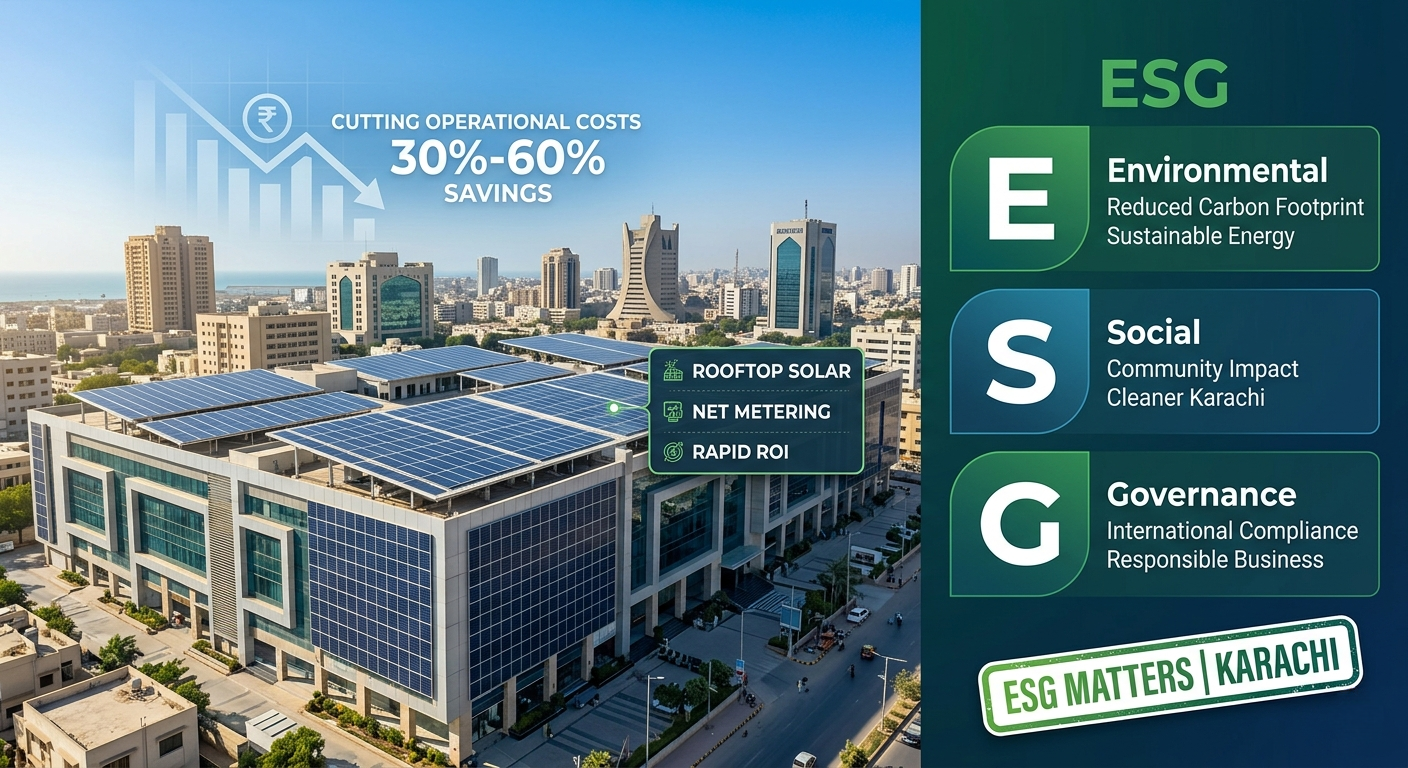
Cost reduction. A rooftop or ground-mounted solar system generates power at a levelised cost of PKR 8–12 per kWh, compared to PKR 60–90+ per kWh from K-Electric for commercial consumers. Over a 25-year system life, that difference is transformative. Most businesses in Karachi see full payback within 3 to 5 years, after which the electricity is effectively free.
Operational continuity. Paired with a hybrid inverter and battery backup, a commercial solar system keeps critical loads — servers, production lines, lighting, HVAC — running through outages. This is not about comfort; for a factory or a hospital, it is about not losing a shift or a patient record.
Stable energy costs. Unlike K-Electric tariffs, which fluctuate with fuel prices and government policy, the cost of solar-generated power is fixed at installation. A business that locks in solar today is hedging against tariff increases for the next two decades.
Why ESG Is No Longer Optional for Pakistani Businesses
ESG — Environmental, Social, and Governance — has moved from corporate buzzword to business necessity for a specific and growing group of Pakistani companies: those with international customers, foreign investors, or export ambitions.
European importers, in particular, are increasingly demanding that their supply chain partners provide carbon footprint data and demonstrate progress toward emissions reduction. The EU’s Carbon Border Adjustment Mechanism (CBAM), already in effect for some sectors, will expand in coming years. Pakistani exporters in textiles, leather, surgical instruments, and agri-processing need to be prepared.
For these businesses, a solar installation is not just a cost play. It is a verifiable, bankable ESG action. It reduces Scope 2 carbon emissions (those from purchased electricity), which can be reported to international customers and auditors. It demonstrates that a Pakistani company is a credible long-term partner.
Even for businesses with no current international exposure, ESG credibility increasingly affects access to capital. Local and international banks are developing green financing products, and companies that can demonstrate sustainability credentials are better positioned for loans, credit lines, and equity investment.
Types of Commercial Solar Systems in Karachi
Not all commercial solar setups are the same. The right architecture depends on your load profile, rooftop or land availability, DISCO connection, and business continuity requirements.
Grid-tied systems connect to the K-Electric grid and export surplus power under net metering (or the newer net billing framework under NEPRA’s 2026 prosumer regulations). They are the most cost-effective option for businesses with consistent daytime consumption and reliable grid access. They do not provide backup power if the grid goes down.
Hybrid systems combine solar generation with battery storage and remain connected to the grid. They offer the best of both worlds: daytime solar savings, battery-powered backup during outages, and grid connection for top-up when needed. This is the most popular configuration for commercial clients in Karachi given the reliability issues with K-Electric.
Off-grid systems are relevant for businesses in areas with extremely poor grid reliability, or for industrial sites where a dedicated power solution makes more economic sense than a DISCO connection. They require larger battery banks and careful load management.
How to Evaluate a Commercial Solar Proposal
Business owners often receive multiple proposals with wide variations in quoted system size, component brands, and pricing. Evaluating these proposals correctly is critical.
An energy audit conducted before installation will establish your baseline consumption patterns, identify efficiency improvements, and right-size the system. Skipping this step is the most common reason businesses end up with undersized or oversized installations.
The Role of an Experienced Solar Partner
For a commercial installation, experience is not optional. A residential solar installer scaling up to commercial work is a fundamentally different animal from a company with a decade of commercial and industrial project delivery behind it.
Sustainable Energies Enterprise has been delivering commercial and industrial solar solutions in Karachi since 2012. Our work spans offices, factories, warehouses, hospitals, and retail chains. We conduct thorough energy audits before every project, design systems that match actual consumption patterns, and back every installation with comprehensive maintenance and after-sales support.
If you’re ready to take your business off the high-cost grid and build a verifiable clean energy story for your stakeholders, we’re here to help.
Ready to explore commercial solar for your business? Contact SEE for a free consultation and energy audit.
Sustainable Energies Enterprise — Karachi’s trusted solar energy partner since 2012.