
Pakistan’s solar market has grown rapidly in recent years. Rising electricity tariffs, falling panel prices, and growing concerns over unreliable power supply have pushed homes, businesses, and industries towards solar energy. This is a positive shift. Solar can reduce bills, improve energy security, and support the country’s long-term energy transition.
But as the market has grown, one habit has also become deeply entrenched: judging solar systems by rupees per watt. Almost every customer asks the same question: What is their rate per watt?
The question is understandable. It is simple, quick, and easy to compare. It gives buyers a sense of control in a confusing market. But it has also created a serious weakness in how solar systems are sold, compared, and understood.
A solar panel may be priced per watt, but a solar power system is not just a collection of panels. It is an engineered electrical system. It includes inverters, cables, mounting structures, protection devices, earthing, monitoring, documentation, commissioning, and after-sales responsibility. Many of these costs do not scale neatly with watts.
Per-watt pricing is a useful shorthand for early discussion and rough budgeting, but it should not be treated as the full truth
Even panels with the same wattage are not always equal. Two 585-watt modules may differ in temperature performance, degradation, mechanical strength, warranty quality, field reliability, and long-term energy yield. If per-watt pricing is incomplete even at the panel level, it becomes far more misleading when applied to the entire solar system.
This matters because a low per-watt rate can hide important compromises. One quotation may include properly sized cables, genuine protection devices, a strong structure, good earthing, clear monitoring, and proper commissioning. Another may use weaker components, copied switchgear, unclear cable sizing, poor documentation, and vague warranties. Both may appear to be the same system if the customer only looks at the final rate.
The issue is not low pricing. Affordable solar is important, especially in a country where energy costs are already painful. The real issue is incomplete comparison. Customers should not be forced to guess what is hidden inside a quotation.
The industry must therefore move from rate-based selling to specification-based comparison. A proper solar quote should clearly state the panel and inverter models, cable sizes, structure type, protection devices, earthing arrangement, monitoring access, commissioning tests, warranties, exclusions, and expected performance assumptions. This is not over-complication. It is basic professionalism.
The problem becomes even more important as systems grow in size. A 10kW residential system may need proper protection, safe wiring, future battery readiness, and reliable after-sales support. A 100kW commercial system may need careful inverter selection, cable routing, MPPT design, zero-export control, and monitoring.
A 1MW industrial system becomes electrical infrastructure, involving transformers, protection coordination, supervisory control and data acquisition, civil works, earthing grids, and long-term maintenance planning. Treating all of these projects as simple per-watt commodities weakens the market and encourages a race to the bottom.
Pakistan’s solar industry is also entering a new phase. The future will not be about installing more panels alone. Storage, load management, smart meters, net billing, export limits, peak-hour tariffs, and energy management systems will make solar decisions more complex. The value of a solar energy system will increasingly depend not only on how much power is installed, but on how much useful energy is delivered at the right time.
This is where better metrics, such as lifecycle energy cost and levelised cost of energy, become important. Customers ultimately save through units of energy, not through nameplate watts. But even these metrics require honest assumptions about generation, degradation, maintenance, downtime, self-consumption, export value, and future tariff changes.
Pakistan does not need to abandon per-watt pricing completely. It can remain a useful shorthand for early discussion and rough budgeting. But it should not be treated as the full truth. A solar project is not a bag of watts. It is a long-term energy asset.
The next stage of Pakistan’s solar market should reward better design, better components, better installation, better monitoring, and better accountability. Customers should ask not only “what is the rate per watt?” but also “what exactly is included, how will it perform, and who will stand behind it?”
Cheap watts are not enough. Pakistan needs reliable energy systems.
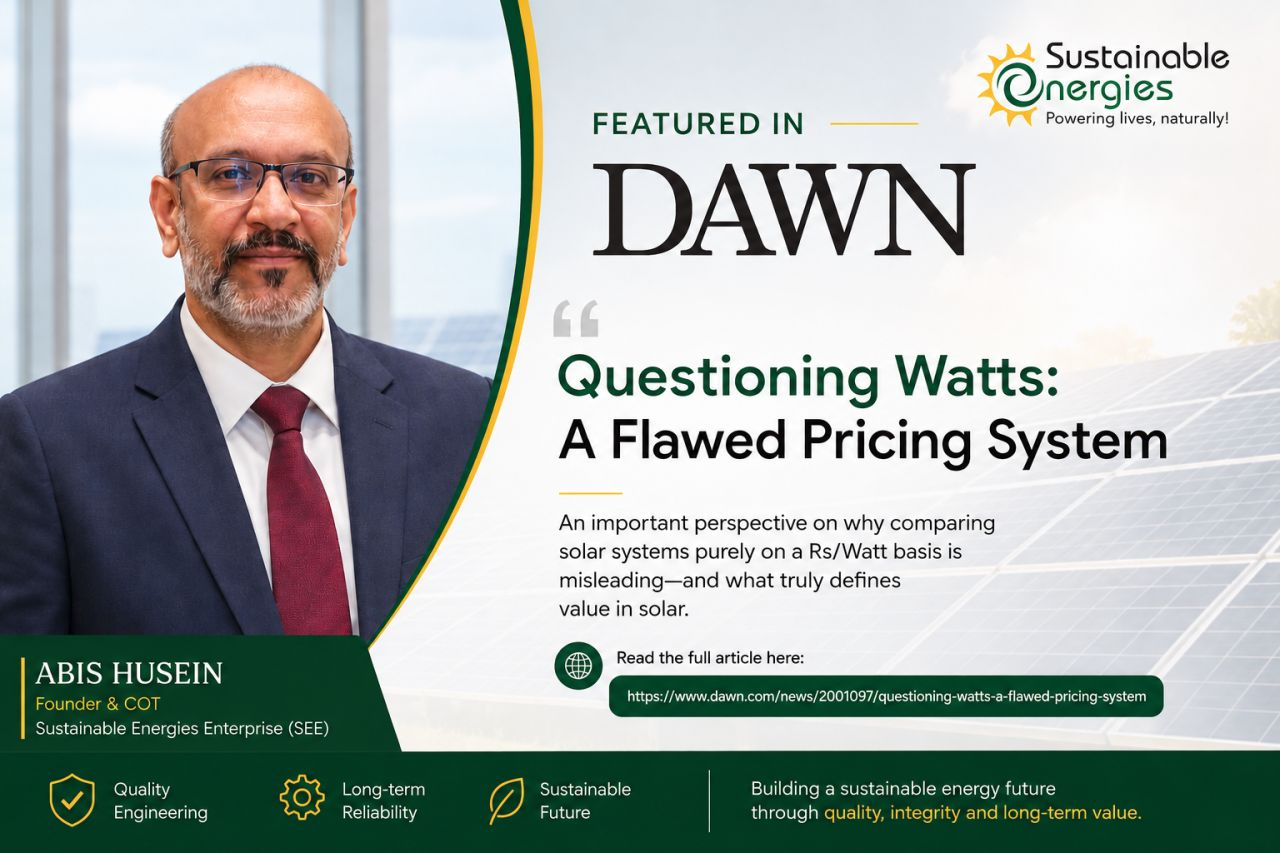
The writer is the founder and chief technology officer of Sustainable Energies Enterprise.
Email: abis.husein@senergies.pk
Published in Dawn, The Business and Finance Weekly, May 18th, 2026